Categories
Finances & Money

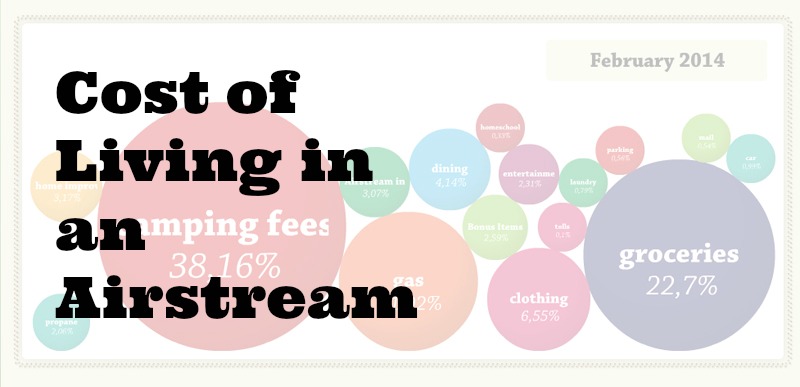
How Much Does it Cost to Live in an Airstream? February Summary

How Much Does it Cost to Live in an Airstream Feb 2014

What amazes me about life on the road is how unpredictable it is. One month can be completely different from the last, but that’s what makes it so exciting! At the same time, variety makes budgeting difficult.

I’ll detail a post later on about how I budget in general (because that’s not really Airstream life specific) but just know that these are not ALL of our expenses. Not even close. These are just the ones that are fairly Airstream specific. We still have health insurance, life insurance, entertainment, loans on the Airstream and truck, HSA contributions, children’s savings, mortgage and utilities on the house in Lehi… You get the idea.

But aside from all that, most people want to know what it’ll cost in the Airstream. The biggest differences for us are the camping fees, higher gas spending, higher groceries, laundry, and occasionally the higher eating out (only because we never really ate out before).

This month we spent 1 week at Disneyland in an RV Park, and then another week in San Diego (actually 2 – but we crossed into March). A little bit of courtesy parking, regional park in AZ, and a National Park in CA. So, pretty varied as far as camping fees go. BUT we also drove less. WAY less. So less gas money. It seems we average out between the two most months.

Here are February’s numbers:

Feb 1st: Halfway between Tuscon, AZ and Phoenix, AZ
Feb 31st: San Diego, CA

Total miles driven: 1,301
Total miles towing the Airstream: 687
Average Towing Miles per Week: 172

Camping Fees (State parks, RV campgrounds): $1029.55
# of Nights Courtesy Parked with a friend/free parking: 2
Gas: $321.59
Propane: $55.70 (way less! Hooray for an electric heater!)
Groceries: $612.45 (also includes all paper goods, and Pull Ups)
Laundry: $21.25
Dining Out: $111.81 (does not include eating out at Disneyland – that was budgeted separately)

Here’s our 3 month average for Dec 2013 – Feb 2014:

Average Miles per Month: 1997
Average Towing Miles per Month: 1194
Average Towing Miles per Week: 99.5

Camping Fees: $23.87/night
Gas: $594.22/month
Propane: $79.44/month
Groceries: $662.56/month
Laundry: $18.42/month
Dining Out: $126.07/month

Not too shabby. We originally budgeted about $40/night average, $700 for groceries, and $700 for gas. So, under on all three! This makes me very hopeful we can continue this lifestyle without too much stress. Hooray!

Categories
Finances & Money

Health Insurance for the Self-Employed

Health Insurance for the Self EmployedOver the last 10 years, we’ve run into a lot of friends, relatives and acquaintances that were thinking about leaving the 9-5 hamster wheel and venturing off on their own. There are definitely a lot of perks. No set hours (unless you get a picky client), you can choose which clients or projects to take on, most of the time you get to work from home, more time with family, etc. The number one logistical technicality holding them back? Health Insurance. For some reason in our American culture, we have traded freedom and flexibility for the idea of benefits from a large (or small) corporation.

I’m guilty as well. When Sam was almost done with his Master’s thesis and we were looking around for the next step, I was giddy with excitement. We were going to have a REAL job, and they were going to give us BENEFITS. I wasn’t going to have to worry about health insurance anymore, it would magically be taken care of for me.

Not the case.

I realized I no longer had control over which health insurance company we would be associated with, that our employer did not pay ALL of our health insurance costs but a portion was still pulled from our paycheck, and that some of the plans really just did not meet our needs. I felt trapped. After years of being in control of our health care I really struggled.

After Sam quit the 9-5 and we went back on our own, I sighed with relief.

So, what do we do for health insurance?

Let me preface this by saying everyone’s needs are different. What I term adequate health insurance coverage may not fit your family’s needs. We are young, healthy, and have no plans to add any more children to our family. I also have not sat down with our health insurance agent to go over our options with Obamacare’s new rules. Since we’ve been on the road, we basically just kept the same plan as last year although there’s probably something better out there. We’ll sit down with him later this spring when we get back to Utah.

We have 3 different plans to cover our needs: and HSA general health insurance plan, Dental Insurance, and a Supplemental Accident plan.

The HSA: $258.51/month

 We have a high deductible ($10,000), Health Savings Account plan. The HSA plan is basically a savings account with a debit card that I spend on medical and health related purchases. Every month I transfer $200 from our personal checking account over to the HSA account (all of our accounts are currently with Chase), and then whenever we have something medical related I pay for it with the associated debit card. Its easier that way because I don’t have to keep track and reimburse myself for purchases. With the HSA account they give you a list of qualified purchases and you have to log in and verify that what you spent does indeed qualify. Over the counter drugs, sick doctor’s visits (well visits are covered 100% under Obamacare), and chiropractic visits are probably our 3 biggest expenses.  The HSA account also rolls over every year so you don’t have to go on a mad doctor spree in December to use all your money.

In a previous post, I talked about having a savings buffer. We have $10,000 sitting in our bank savings account to cover our deductible (or anything else for that matter). Yes, its a high deductible, and I’d probably cry if something happened and we had to use it but it also wouldn’t break us. We would recover. That’s what insurance is for anyway right? To provide relief so that any imaginable situation is not un-recoverable.

Dental Insurance: $54/month

Our agent found us a cheap one. We’d never really had dental insurance, but Sam has notoriously bad teeth and I figured we probably needed something for the rest of us as well. For a few years I just paid out of pocket, but that got old and really expensive. I’m still undetermined if it actually saves us money in the long term, but we’ll go with it for now.

We have dental insurance through a smaller Utah company called Total Dental Administrators of Utah, Inc. (TDA for short). You basically choose from their very small list of providers and set a dentist that you’ll go to every time. The insurance has a discounted price for what different procedures cost, and you pay that at the office. We chose the dentist recommended and used by our agent. He’s great. Probably my favorite dentist since we’ve been married actually. Nice office, close to home, and does great with the kids. Downside is that its in Utah so if we keep this plan we’ll have to travel through once a year and set up visits.

Supplemental Accident Plan: $53.10/month

This was also recommended by our agent. It basically covers any unforeseen accident. Whether its Sam using tools and he slices something, or one of the kids breaks an arm jumping off rocks we are covered. This gives me piece of mind that if something catastrophically accidental occurs our insurance will pay up to $7500 per person with only a $100 per person deductible.

While our insurance isn’t perfect, and does take a bit more effort than going through a company, I really like being in control of it. I’m actually excited to go back to Utah, sit down with our agent and discuss the best options that are available for us. For those of you that are on the road or self-employed what have you found for insurance that works for you?

Categories
Finances & Money Selling Our Stuff

To Sell, or Not to Sell? What to Do With the House?

To Sell or Not to Sell. What to do with the House
Traveling so far we have run into so many families that have sold everything for their life on the road. Whether out of necessity, or to just downsize and live simply, selling the house and everything in it is one way to fund and maintain a life on the road.

Others we have run into rent out their house or simply leave it empty if they know they will be back. Many families are out for a year or so, quitting their jobs, pulling the kids out of school and living on savings. This makes sense to keep the house since their return is inevitable.

Leaving Utah last July we never imagined we’d end up with an Airstream and want a life on the road. As such, we still have a house in Utah we need to go home and deal with. Our home exchange partners have left, so we have friends keeping an eye on it for now, but we can’t ignore the giant hole that our money is draining down.

The problem is, we love the house. Well, maybe we love the idea of our house. It’s our first one. We brought Cara home from the hospital to that house. We put a lot of love, sweat, and tears into turning it into our home. The idea of selling frankly scares me to death. Our kids are adamantly against it and I don’t really blame them. Prior to traveling, a large portion of their identity revolved around where we lived. We live around the corner from our best friends and it would be really hard to give that up. Plus, I just finished sprucing up my office and I love it. Being in there makes me happy.

Being on the road makes me happier. There’s the problem.

As a culture, why is it we become so attached to things? Even thinking of selling our dining room table that we hunted for, or the downstairs couch I agonized over and went to 5 different stores before picking out the perfect one makes me want to break down in puddle of tears. Why is that? We’ve gone over and over it. Its just stuff. Its replaceable. We never wanted to end up in Utah anyway. But why is it so hard?

So there’s our current dilemma. To sell? Or not to sell. We’ve been told the REAL estate market in Utah is great for sellers this year. If we are going to sell, now is the perfect time. And yet, we are all not sure if we can let go. We hope we’ll know when we get back there. Most of our journey so far as been by faith, and I think this will have to be as well.

Just to get nostalgic – I thought I’d share a few photos of our cute house with you. You know, because in another few months it could be on the market.

IMG_4896IMG_0042IMG_0053


Categories
Finances & Money Most Popular Posts

How Much Does it Cost to Live in An Airstream? January Edition

How Much Does it Cost to Live in an Airstream Jan 2014Another month gone by! Time seems to be flying. Another month means we re-evaluate the biggest questions: How much money is it going to take? Can we really make this work?
Comparatively, January was better than December. I think. We definitely spent less money on camping fees (staying with friends, boondocking, and turns out New Mexico State Parks are ridiculously cheap). However, what we saved on camping fees we spent on gas as we are still traveling too fast. It was also very cold for a bit there so we spent more on propane.

Going into February we definitely predict camping fees to go up. Moving into California, we will have a week in Disneyland at an RV Park, plus California State Parks are just expensive. We have put into motion the acquisition of a generator and that will help with recharging our batteries and giving us more flexibility on where we stay.

Enough talk. Here’s the numbers for January:

Here we go:

January 1st: South Houston, TX
January 31st: Halfway between Tuscon, AZ and Phoenix, AZ
Total miles driven: 2,443
Total miles towing the Airstream: 1,666
Average Towing Miles per Week: 416

Camping Fees (State parks, RV campgrounds): $276.70 ($15.37/night average)
# of Nights Courtesy Parked with a friend/free parking: 13
Gas: $834.19
Propane: $98.99
Groceries: $598.90
Laundry: $4.25
Dining Out: $85.83

And here are December’s just for comparison. Next month I think we’ll do a 3 month average:

December 1st: Tampa, FL
December 31st: South Houston, TX
Total miles driven: 2,247
Total miles towing the Airstream: 1,228
Average Towing Miles per Week: 277

Camping Fees (State parks, RV campgrounds): $842.45 ($31.20/night average)
# of Nights Courtesy Parked with a friend/free parking: 4
Gas: $626.88
Propane: $83.62
Groceries: $776.32
Laundry: $29.75
Dining Out: $180.58 (ouch! I didn’t think we ate out THAT much. It must’ve been the beignets in New Orleans!)

Obviously there are more expenses (clothing, entertainment, decorative upgrades, etc.) but these are the main ones. The thing is, what it costs to live on the road is highly subjective. Just as living in a house can be. How nice of an RV Park or Campground do you want (camping fees)? How far are you traveling every week (gas)? How many people in your family (groceries)? How cold is it outside (propane costs)? What do you like to do for fun (entertainment)? These costs completely vary from family to family just as they would in a brick house.

If you’d like another opinion on costs of traveling full-time, our instagram friend Kyle has a great article that breaks down various costs on his blog Where Is Kyle Now? Go check it out and let us know what you think!

Categories
Finances & Money Most Popular Posts

Our Number One Recommendation to Prepare Financially for Life on the Road

Our Number One Recommendation to Prepare Financially for Life on the RoadAlthough it may seem like we jumped into the decision to abandon our lifestyle and go mobile, it has actually been a long time in the making. We didn’t just wake up one day and decide to sell the minivan, buy an Airstream and a truck and drive into the sunset.

So, what did we do?

Our biggest concern as we started planning and scheming was money. How would we afford this? Not just the everyday life, but the initial purchase of both an Airstream and a truck. We had 3 month’s worth of money saved in the bank as an emergency buffer (good idea in anyone’s situation I think) but in no way was it enough to cover the purchases. We definitely needed to finance, but wanted to make sure we’d still have money every month to buy groceries and gas after the monthly payments. As we started looking at our bank accounts we realized there were a few helpful things we were already doing.

1. We paid off our minivan in the spring of 2012. Instead of using that “extra” $600 for day to day life (however tempting that might have sounded) we began paying into a separate “car fund” savings account at our bank so that next time we needed to buy a car we could pay for it in cash. Separate account made it less tempting to spend.

2. We have been a 1 car family since the summer of 2012. Our Ford Focus’ engine died right before we left for California for 5 weeks. We eventually sold it on Craigslist and figured we’d buy another car when and if we needed it. We never have. We do realize Sam working from home really helps this situation. I’m definitely not the type of wife to be stuck at home while my husband has the car all day at work, but I could do it if necessary. If he had a commute, Sam could also bike, take public transportation, or carpool a few days a week so I could have the car to run errands. Lots of possibilities to free up a few hundred dollars a month.

3. We had maxed out our emergency buffer savings account and started putting that $500 into the car fund in addition to the $600 we were already saving.

We totaled up the amount in the car fund and it was a hefty enough sum to put a $5000 down payment on a used truck to lower our monthly premium while not completely draining the account. Once all our loans went through (that’s a different story – not many banks will loan to the self-employed) our monthly payments totaled $829, which turned out to be $270 LESS than the amount we were currently saving into the car fund. Our purchases of both a truck and the Airstream were not going to cost us any extra money per month. After we sold our minivan, that money went back into our savings account & car fund to bring those back up to reasonable levels. We still put that extra $270 into the car fund every month as we anticipate new tires, new batteries (did that one last week), and other improvements or repairs we’ll need to do along the way.

This brings me to our Number One Recommendation to Prepare Financially for Life on the Road:

Live below your means.

Well below your means if you can help it. I can’t tell you how many months I wished we had more money for eating out, taking the kids to movies, going on fun vacations, even groceries. Not stressing about my grocery budget would have made my life so much simpler. I’d look at that account transfer every month and think, “But if we just used a little of it…”

You know what? It was worth it. Every time we scrimped, every time we decided to not make a big purchase but instead save the money, every time I made dinner instead of eating out, we were one step closer to our dream.

Fulfilling and living our dream took sacrifice and planning. It hasn’t been an easy road (it still isn’t) but knowing that we are actually doing what we’ve always dreamed about is better than anything else we could have bought.