Categories
Finances & Money

Paid Vacations for the Self-Employed

Paid Vacations for the Self-Employed

One clear difference between self-employment and a salaried job is the lack of paid vacations. I am paid hourly so when I don’t work, I don’t get paid. Without a bit of advance planning, it is easy to feel like I can’t take time off or relax without feeling the financial burden.

Having just spent a Christmas without that worry, I thought I’d share how I balance work and time off.

My secret is simple: I plan to complete the necessary work in 20 working days per month. Every month (except February) has more then 20 week days. This allows a few extra days per month for time off. I don’t have to wait for the end of the month for those extra days. I use them during the month as convenient. As long as I get 20 working days in during the month, I know I’ll make enough money. If I don’t need the vacation days, I’ll work like normal and save the billable time/money for days that I do want to take off.

Using this method, 2013 provided 21 extra week days:  enough for a full month off. I’ve used that time for sick days, birthdays, holidays, “mental health” days, and if I choose to work, “bonus” money.

This math also makes it easy to figure out how much money I need to bill each day: I calculate my pre-tax monthly required income (paycheck + income tax), and divide by 20. That is the dollar amount I need to invoice each day. Divide that amount by my hourly rate and I get how many hours I need to work on each work day.

Should I want additional time off, I work more than my hourly requirement on days where nothing too exciting is happening. There are some days I settle in and work 8-9 hours instead of my normal 5-6. This allows me to get ahead and build up some extra vacation days. I bill monthly (see my How We Travel Without Being Independently Wealthy Post) to allow me the flexibility to average my hours over a longer period of time. Billing every two weeks would shorten that time span, but can also work well.

Time easily converts to money: If I want a bonus instead of time off, we bill for the extra hours I work instead of saving that time for vacation.

Because I know my plans rely on a 20 workday month, I’m free to enjoy my days off without stress and worry.

Questions? Confused? Please ask!
 

Categories
Finances & Money

How Much Does it Cost to Live in an Airstream? December Edition

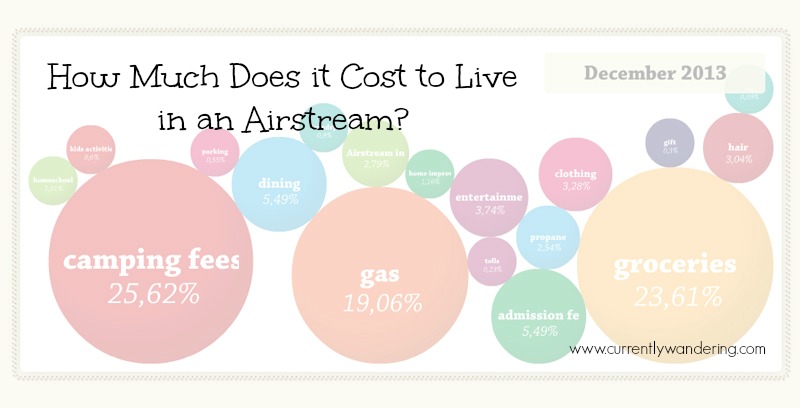
How Much Does it Cost to Live in an Airstream Dec 2013Sam & I talk often about the costs of living on the road full time. How much money is it going to take? Can we really make this work? Honestly, we are not sure yet. We have a few numbers in mind from our own experience as well as others’, but because we are so new at this we don’t have much data yet.

As an experiment, we thought we’d do a monthly summary of our main expenses over the last 30 days or so. We felt like this would give our readers a general overview of what it takes financially, as well as give us a running comparison of numbers. So, here we go:

December 1st: Tampa, FL
December 31st: South Houston, TX
Total miles driven: 2,247
Total miles towing the Airstream: 1,228
Average Towing Miles per Week: 277

Camping Fees (State parks, RV campgrounds): $842.45 ($31.20/night average)
# of Nights Courtesy Parked with a friend/free parking: 4
Gas: $626.88
Propane: $83.62
Groceries: $776.32
Laundry: $29.75
Dining Out: $180.58 (ouch! I didn’t think we ate out THAT much. It must’ve been the beignets in New Orleans!)

Obviously there are more expenses (clothing, entertainment, decorative upgrades, etc.) but these are the main ones. The thing is, what it costs to live on the road is highly subjective. Just as living in a house can be. How nice of an RV Park or Campground do you want (camping fees)? How far are you traveling every week (gas)? How many people in your family (groceries)? How cold is it outside (propane costs)? What do you like to do for fun (entertainment)? These costs completely vary from family to family just as they would in a brick house.

There are definitely plans in the works to cut down on both camping fees and gas (just bought new batteries for the Airstream, we’d love some solar panels, traveling SLOWER). Getting to milder climates will also save on propane, and dang. We could definitely eat out less. That number still surprises me. Was it the seafood? The ice cream?

If you’d like another opinion on costs of traveling full-time, our instagram friend Kyle has a great article that breaks down various costs on his blog Where Is Kyle Now? Go check it out and let us know what you think!

Categories
Finances & Money Most Popular Posts

How We Travel Without Being Independently Wealthy

How We Travel Without Being Independently WealthyMany of the folks who hear our story assume that we are somehow financially set, that we have the money to traipse about the country living off savings or other residual income not tied to daily involvement. You might be surprised to discover that our finances are likely not very different from yours.

We are not independently wealthy. We pay a mortgage on a house in Utah where we lived for several years before setting off. We are paying off loans for both the truck and the Airstream. Our short term financial buffer would be depleted within months without me bringing in a paycheck.

How can we do this then? We’ve made time with our family a priority, and we sacrifice less important things. Jess does an amazing job feeding our family with a reasonable food budget. We rarely eat out. When we do, it’s either one of our standby ‘feed the family for less then $20’ meals or we are splurging because the local food is rumored to be amazing. We have national passes for Science Centers, National Parks, and Zoos/Aquariums. This allows Jess to take the kids on excursions without spending a lot of money. She also takes them to libraries, on bike rides, or to the park, just as she would were we leaving in a regular house. I work a reasonable portion of each day to earn money, and we trade having things for spending time together.

There are plenty of useful details about how we do this, and we’ll post more over time about the details. For now, here is a quick summary of what I do for work:

I am self-employed. No health benefits, no salary. I do long-term consulting for a few clients, and I bill my time hourly. This allows me to know exactly how much I need to work in order to pay the bills. Need extra money for Disneyland? Work extra hours. While it is a direct time for money scenario, it also gives me unlimited earning potential should I choose it.

For my clients, I program and do software and system architecture design, working from a laptop with a Verizon Mifi for internet access. I spend an average of 5 or 6 hours, 6 days a week working. Between driving and adventuring, its easier to break work out over 6 days rather than 5.

I bill monthly. We get paid monthly. It means we have to budget more carefully and make the money last, but its also less hassle than every 2 weeks. We prefer it this way.

The key, for me, to staying engaged and focused on work is to work on stuff I am really passionate about. A really great set of headphones doesn’t hurt either. I have more then enough work for the time I wish to spend working, and it is very rare that I accept additional work. I have clients that understand my chosen lifestyle and work with me, allowing time and location flexibility.

We realize we are blessed with a job that works well for traveling. One of the many reasons we feel that not only CAN we do this, we SHOULD. There are many jobs or other employment that allow for long-term travel. If this lifestyle is something you are interested in, definitely look around and explore your options. Talk to other traveling families and see what they do. If you want it bad enough, you’ll work something out. Where there is a will, there is a way.