Categories
Airstream Accessories General Information The Airstream Tips & Tricks Tow Vehicle Travel

Gear Review: EEZTire Tire Pressure Monitoring System

Worried about your RV or Airstream tire blowing out? The EezTire Pressure Monitoring system is easy to install and use. Check out our post for details!My first experience with a tire blowout on the Airstream was only the second time I towed it. We were headed back to Virginia after picking up the Airstream in Carlyle, IL. (This was back in the fall of 2013.) Our second tow was from Louisville, heading East. Our destination was Lake Vesuvius, right at the southern tip of Ohio. Just miles away from our destination we passed through Ashland, Kentucky. Before we made it through town, we were flagged down by an angel in the form of a middle aged man, who informed us that we had blown a tire on the Airstream. We immediately pulled off the road into a church parking lot, then moved just down the street to have a tire place help us replace the blown tire with the spare.

We were incredibly lucky: no damage was done at all due to the warning and help we received from those blessed folks of Ashland. I felt a little dumb, as the previous owner had included a PressurePro TPMS (similar, but not exact, product link) when we purchased the Airstream. I hadn’t yet taken the time to figure it out yet, so it was not hooked up at all.

I quickly did figure it out, and we have used a Tire Pressure Monitor ever since. These systems consist of a monitor that you place in the cab of your truck, and a sensor that screws onto the outside of the tire valve stem of each tire. The Pressure Pro system I inherited had 6 sensors: all 4 Airstream tires and two for the back tires of the truck. I loved the assurance that came with having monitoring pressure on the tires, and I loved having an alarm sound when pressure dropped on any of the tires.

After a year or so, I began to have a few issues with a few of the tire sensors. Pressure readings were intermittent, and replacement was expensive. My search for new sensors also revealed newer (and cheaper) systems that not only monitored pressure, but tire temperature as well.  After some research I decided upon the EEZTire system, complete with 8 tire sensors.

Monitor

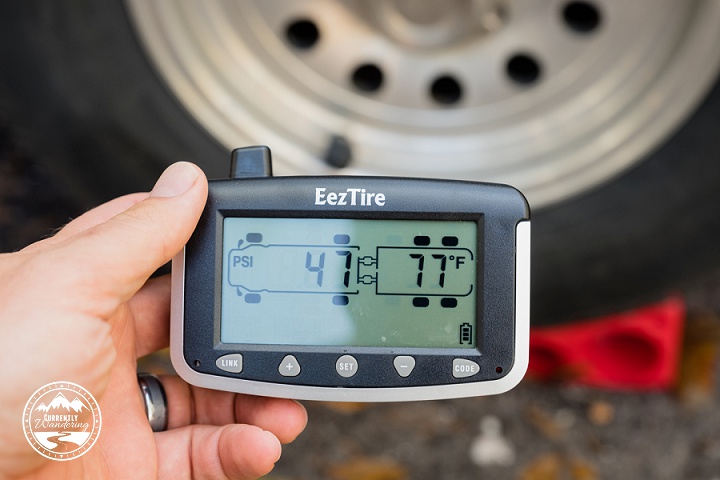
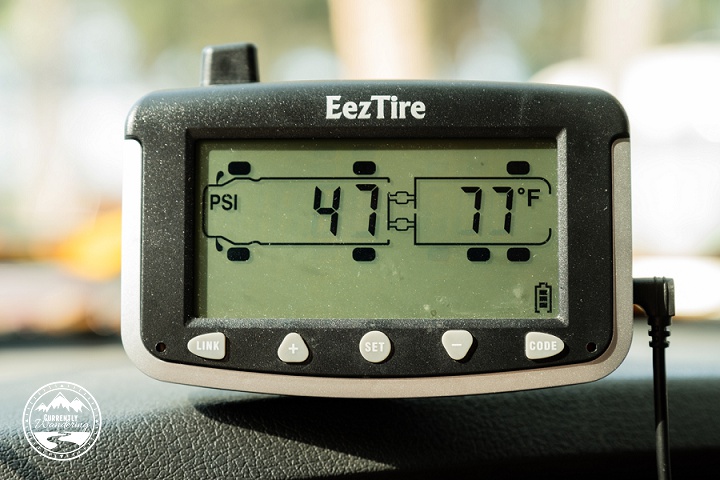
The difference between the PressurePro system and the EEZTire system was profound. The EEZTire monitor has an internal battery, which made setup fast and easy. After mounting the sensor on each tire, you program it to the monitor by entering setup mode, selecting the appropriate tire on the display, and holding it next to the sensor. The monitor does have a DC power cord that we use in the cab, but more than once I’ve used the portable monitor to make my life easier. (More on that later…)
DSCF3294

Sensor Types

There are two types of sensors offered by these systems: Regular and flow-through. They both report the same information, but the flow-through sensors have an air port you can use to add air to the tire without removing the sensor. I have found that feature to be useful, though it does seem to restrict the airflow a bit. I suspect the regular sensors are slightly simpler inside, which may turn out to be more reliable in the long run.
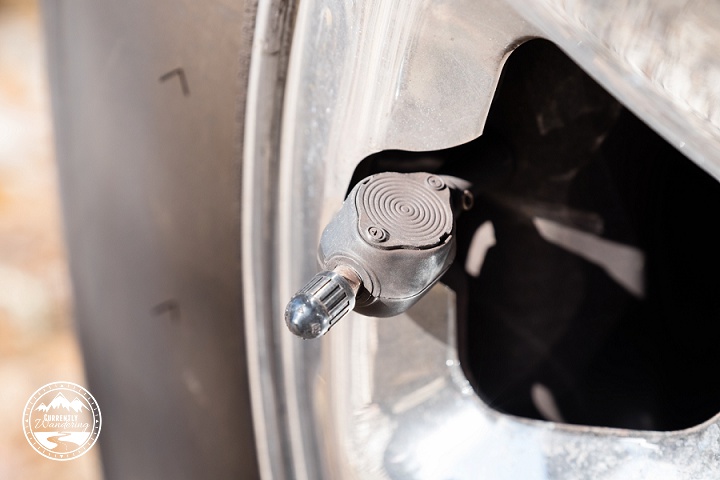
DSCF3285

Proper Sensor Installation

The absolute most important thing about installing your TPMS sensors is getting the sensor on tight enough. If the sensor is improperly installed, then air will leak out of the valve stem, giving you a flat tire. If you read reviews of every after-market TPMS, this will be the top complaint. I myself struggled with this after I installed my new sensors. The best way to ensure good mounting is to take the portable monitor into the Airstream with you, and watch the pressures. As the tires cool down they will drop a few PSI, but any more than that, and you’ll want to check on the tire. Watching the monitor closely your first few days can help you avoid finding only 10PSI in your tire minutes before checkout time at the campground. In extreme cases, a valve tool (available at any auto-parts store) can be used to adjust the inside seal of the EEZTire sensors.

The good news is that after proper mounting and installation, I have had very little issue with my sensors. They have already come in handy, alerting me to a flat tire that resulted from a metal pin in my tire.

Repeaters

Most TPMS makers sell a signal repeater that can be used on very long rigs. In my case, a 27 foot Airstream and a Dodge Ram extended cab short bed truck, no repeater has been necessary.

Benefits of my upgrade:

  • Internal battery allows mobile monitor use and easy setup.
  • Pressure AND temperature monitoring.
  • Cheaper price.
  • Easy (but slightly futzy) self-install.
  • User-replaceable sensor batteries.

If you are towing an Airstream or other travel trailer, I highly recommend a TPMS. It pays for itself in a single blowout by limiting damage. With multiple-axle rigs, it can be very difficult to tell that a tire has blown, leaving the tire to come apart and tear out the wheel-well and rv internals along with it.
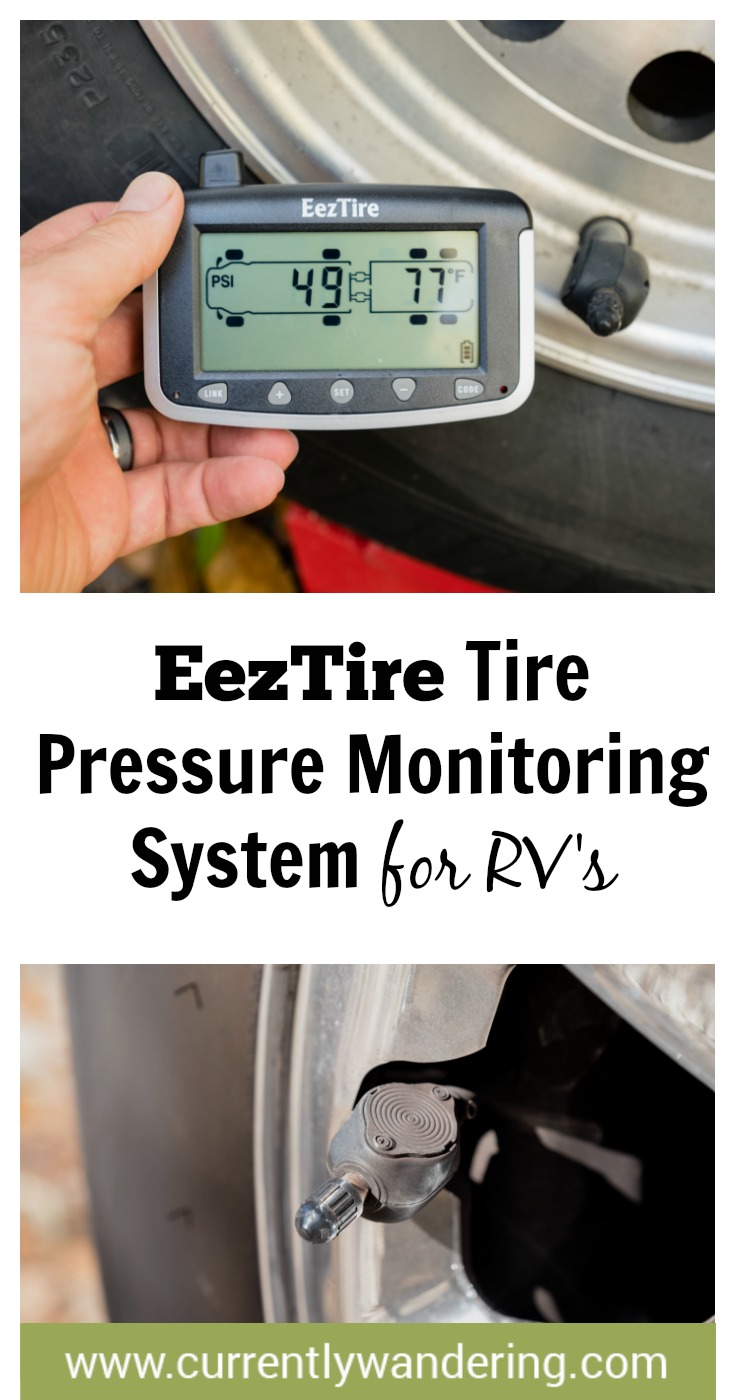
Worried about a tire blowing out? The EezTire Pressure Monitoring system is easy to install and use. Check out our post for details!
Categories
Tow Vehicle

Take Your Garage With You – Retrax One Truck Bed Cover

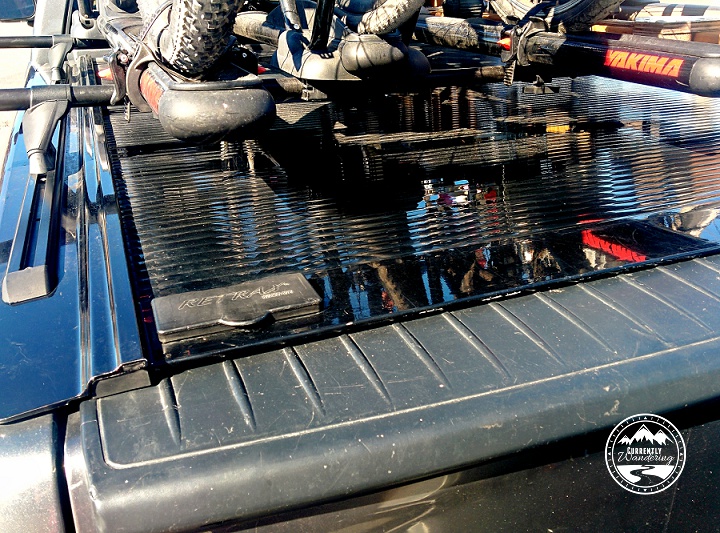
IMG_20150213_102942After purchasing our truck, I began searching for a great way to keep items in the bed of the truck secure and out of the weather. The market is full of various truck bed covers, which turn out to be called Tonneau Covers.
They mostly fall into the categories of roll-up vinyl, hard top, folding, and roll-up. Vinyl, often secured with velcro around the edges, is the cheapest option. Hard top has the best weather protection and folding has the most durability, but I chose a roll-up cover because it would fit and operate with a low profile.

The cover locks in any position, and rolls up easily into a canister at the front of the bed. It blocks water about as well as any of the non-hardtop truck bed covers. I was able to mount Yakima tracks on the edges of the bed cover, providing us a way to mount and carry our bikes and tow our Airstream at the same time.

I usually do hardware installs myself, but I had this done for me by the folk at American Truck and Trailer Supply in Manassas, VA.

In addition to the enhanced storage area, I immediately noticed the increased gas mileage. I have not done a fully scientific test, but it appears that the addition of the bed cover increased my fuel efficiency by 10 to 15 percent. Even if you are not going to be traveling full-time, you would easily recover the cost of a cheaper bed cover in the cost of gas alone.

In addition to the cover, we also added a lock to our tailgate to keep everything secure- see that post here.

If you want to see how we load the back of the truck and what we put in it – check our YouTube video here.

Over a year later, we are still happy with our Retrax One Truck Bed Cover and would choose this one again if for some reason we needed a replacement!

Categories
Biking Outdoor Gear Tow Vehicle

Gear Review: Bike Racks for 5 on a Dodge Ram 1500

IMG_9620-Edit

We started this journey over a year ago with our bikes on a rack attached to the back of our mini van. Biking is one of our favorite family activities and we knew they would be important to have with in the Airstream as well, but that required a significant re-arrangement of our current system.

For starters, we sold the mini van and bought a truck.

Sam wrestled long and hard with the dilemma of where to put the bikes. We went back and forth on a few different systems, and there were some key deciding factors. We knew that we would want a cover over the bed of our truck and that would have an impact on which rack system we used. We also knew we’d be upgrading and changing bikes as the kids got older, so the system needed to be flexible. Lastly, we didn’t have crazy amounts of money to sink into this since we had just bought the Airstream and truck. Anything we could put off until later would be great.

Many of our Airstream friends have the Airstream Carry-Bikes by Fiamma, which is a great option for them. Designed specifically for the Airstream, it mounts to the aluminium bumper and can hold two bikes. Our problem would then be, where do we put the other 3? Plus, our bikes for the kids are not full sized and would most likely not fit in a rack like this one. The other down side is that we specifically picked our model of Airstream for the rear panorama windows and didn’t exactly want bikes blocking the view.

We loved our Yakima system on the mini van, but we sold our previous Yakima system with the vehicle since the bars and towers wouldn’t work on the truck anyway. That left us starting from scratch.

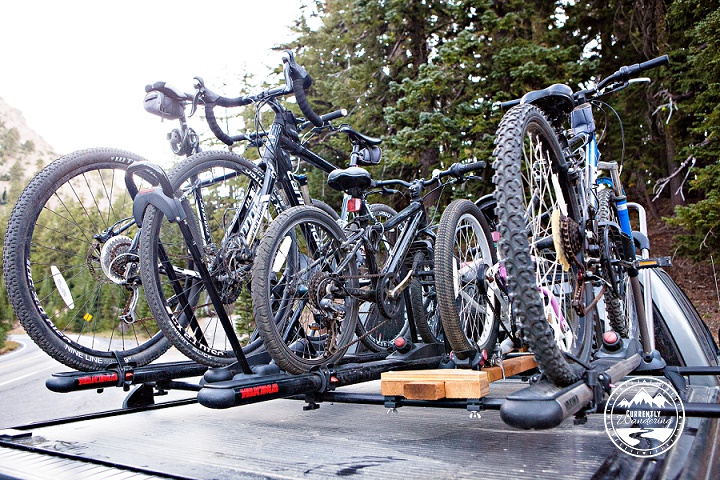
Eventually we decided to add the Yakima rails to our Tonneau cover, even if it wasn’t the cheapest option availabe.  We bought a set of Yakima 60 inch tracks from Amazon and took them to the guys over at American Truck and Trailer Supply in Manassas, VA and had them install the tracks along with the truck cover.

Once the tracks were in, we could add the towers & bars. For our Dodge Ram 1500 specifically we bought:

2 sets of Yakima Landing Pads
Yakima Control Tower Roof Rack Tower (set of 4)
2 – 78″ Yakima Roof Rack Round Crossbars

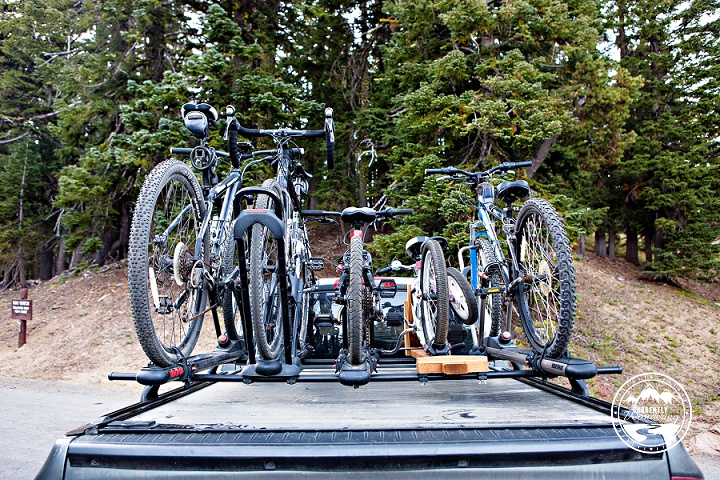
Landing pads go in the tracks, Towers go in the landing pads and crossbars go through the towers. Its a great set up, and has worked pretty flawlessly over the last year.

Once the infrastructure was in place, we just needed the racks for the bikes. We already owned two Yakima Boa Fork Mounts, so to keep costs down, we decided to start with two of those for the biggest bikes. We found a Yakima High Roller Rooftop Bike Rack on Craigslist for Rachel’s bike, and Andrew’s bike, the boot scoot, and the Co-pilot were all piled in the older model Yakima Basket case we had brought out with us from Utah.

This set up worked great for 6 momths until we got back to Utah in the spring of 2014 and upgraded Andrew to a larger bike. We also wanted to reclaim the truck bed space taken up by our bike tires due to the fork mount of the Boa racks, so we upgraded all of the racks to the High Rollers, and Sam built a wooden rack for Cara’s new Ride-aLong bike we had purchased while in San Diego last February. We strap Cara’s boot scoot to the Ride aLong with some bungee cords and it rides just fine.

So far, so good! We’ll have to do some more rework when Cara graduates to a regular bike (or one with training wheels), but we are putting that off as long as possible!

IMG_9621-Edit

Categories
Tow Vehicle

Truck Purchasing Decisions

IMG_2192

We got an email asking us about our truck purchasing decisions. The email ended up being long enough that I gave it a rework, and here it is as a blog post! Consider this an open invitation: If you want to hear about something we don’t have posted to the blog, email us!

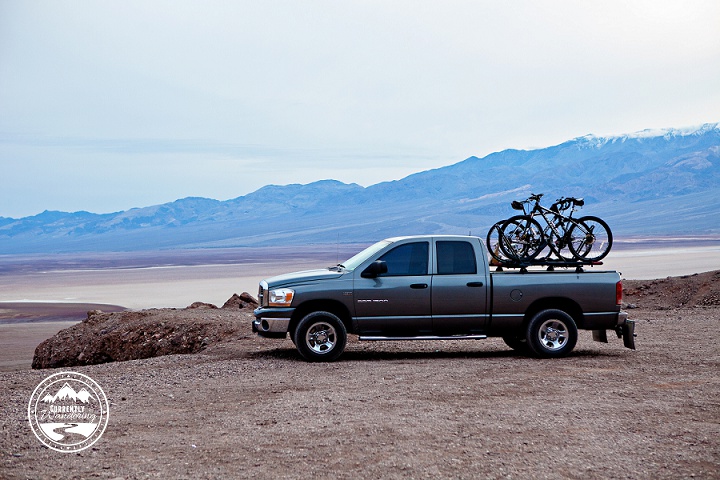
Choosing a tow vehicle can be a complicated decision. We tow with a 2006, Dodge Ram 1500 5.7 Hemi, rated for 10,000 lbs of towing capacity. It is unlikely that you would make the same choices we did, but I’ll talk about our reasons, and hopefully that can help your own decision. We bought the truck used in Virginia over a year ago, and it has served us well.

How did we end up with this truck?

The answer isn’t quite as involved as you might think. We went truck shopping primarily by towing capacity. The max weight of the loaded Airstream (27FB) was 7,500 lbs, so I wanted a truck in the 10,000 lb towing capacity range.

Part of that capacity difference is the stuff we have in the truck while towing: 5 humans (through 3 are smallish), 5 bikes, a generator, and other miscellaneous stuff in the back of the truck. It’s worth knowing that the auto industry is going through a conversion of towing capacity standards. My 10k rated truck would be rated lower under the new standards, though I’m not sure how much.

The truck we ended up with was the beefiest 1/2 ton Dodge Ram 1500 you can get. (The Sport models of the Ram 1500s can only tow 2.5k or thereabouts.) It has been a good truck, including towing some fairly serious grades on long highways. I have added 2000lb airbags on the truck, as the leaf springs were getting tired. Those help quite a bit, as well as the weight distribution hitch we use. The Ram 1500 has been good from a size perspective. As it is our only car, Jess drives it into cities and elsewhere (sans Airstream) when exploring with the kids, and a huge truck would make that much more difficult.

Why a truck?

You can tow with SUVs and vans, but a truck has two great advantages in our case. First, I can mount the bike rack just above the top of the bed. This leaves plenty of room up there for 5 bikes without getting insanely tall. Second, the covered bed area gives me a perfect place to store ‘garage’ items. I store a generator back there, and because it isn’t space shared with humans, I don’t have to worry about gas vapor in the vehicle interior.

Why Gas?

Because I understand gas engines better than diesel engines. That’s about my only reasons there. I’m certainly not opposed to diesel, and the low speed torque advantages are nice. Perhaps a future truck will be a diesel, but I’m not going to start with that as a requirement. I outperform semi trucks on grades while keeping the RPMs under 4k, and it has been good enough for me.

Why Dodge?

In my general opinion, Dodge does a better job at body and drivetrain, but worse at interior comforts. If I had to choose between an air vent failing and the transmission having issues, I’d go with the air vent problem… 🙂 Ford does better at interior, but seems to have more drivetrain issues. Really though, I’m not really stuck to Dodge.

Would I buy the same truck again?

Possibly. I might be tempted at a 3/4 ton truck, though I would look for one with the smallest body possible. I would go looking by towing capacity again, though against the new standards. With growing kids, I might look for a truck with a larger back seat to handle longer legs. We have the mid sized cab and it works, but larger legs would need more space.

Tow vehicles in the full time community are varied, and unique to the individuals who own them. We have friends who tow with beefy vans, Tuareg’s for the smaller Airstreams, and plenty of diesel trucks. Do you research and decide what is important to you!

Categories
Tow Vehicle

New Brakes – A worthy purchase

As we traveled north of Crescent City and across the border into southern Oregon, I began to notice some odd sounds from the front brakes. I knew the brakes were probably due for replacement, and I arranged for some work in Grants Pass, OR.

Finding a place for vehicle repairs is something I do very different on the road. At home, I had a regular mechanic, whom I trusted and did great work. If I needed specific work, he was able to refer me to someone he trusted. On the road, I have tended to visit and use larger chain suppliers for routine work. They are much easier to find, and I can return to any location for any warranty issues. My choice for the brakes was Les Schwab. As usual, the minor signs of wear belied the damage done, and the I needed new rotors in addition to the usual replacement parts. All told, I was just under $900 out the door for the work.

Did I overpay? Probably. But hunting down a mechanic or comparison shopping would have cost me time that I would have otherwise spent working. As I have no end to my current list of my projects, time spent working is worth preserving, even at a little cost.

Mostly, I’m grateful.

Brake problems are very serious when your rig weighs 15 thousand pounds, and we have driven our share of hills recently. Sometimes I catch a brief glimpse of the protection sent from on high to guide us and protect us in our travels, and this is definitely one of those times.

I’m sure that the increased hilliness of our travel accelerated the wear on the brakes, and I was unprepared and not careful enough to watch them. In particular, the wear on the front and rear brakes was about even, no doubt to the additional load on the truck while towing the Airstream. Regular vehicles usually need the front brakes replaced twice as often as the rear, but I suspect towing we will see more even wear.

In the future, I’ll be more careful and more watchful of my brakes.