Categories
Finances & Money

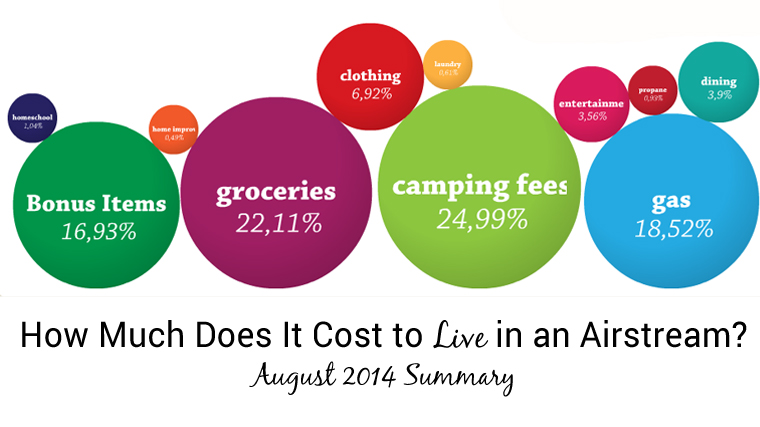
How Much Does It Cost To Live in an Airstream: August 2014 Summary

Airstream Living Cost template copy

August has been great! We spent the majority of our time along the coast between Willits, CA and Crescent City, CA. We then meandered into Oregon seeing the Oregon Caves National Monument, Medford & Ashland, Crater Lake and finally into our boondocking spot in Bend. Oregon has been great so far!

I’ll detail a post later on about how I budget in general (because that’s not really Airstream life specific) but just know that these are not ALL of our expenses. Not even close. These are just the ones that are fairly Airstream specific. We still have health insurance, life insurance, entertainment expenses, loans on the Airstream and truck, HSA contributions, children’s savings… You get the idea.

But aside from all that, most people want to know what it’ll cost in the Airstream. The biggest differences for us are the camping fees, higher gas spending, higher groceries, laundry, and occasionally the higher eating out (only because we never really ate out before).

I really do hate having a budget and I’ve always been terrible, but I suppose it is one of those necessary evils. Let’s take a look at how August went.

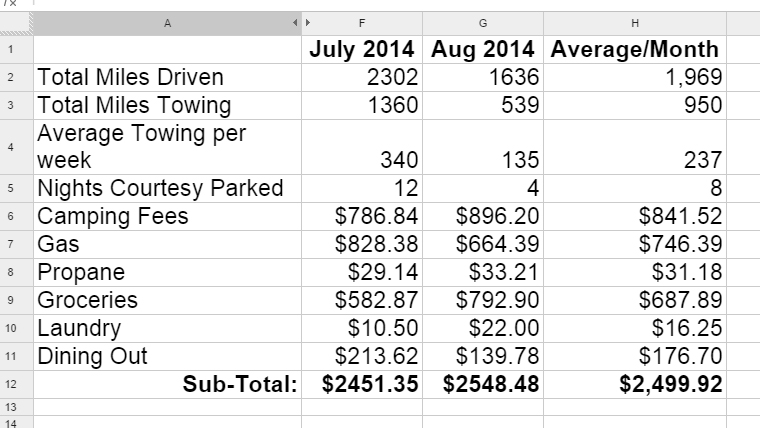
Spreadsheet for August 2014

We seriously went almost no where! lol! We couldn’t believe only 539 towing miles. Yeah. We don’t like to move very fast. Camping fees higher, but still under our $1000 budget for the month. Groceries… well, I probably went to Costco too many times and stocked up on things we probably didn’t really *need*! Oops. Overall, we are pretty happy with the numbers still!

Categories
Finances & Money

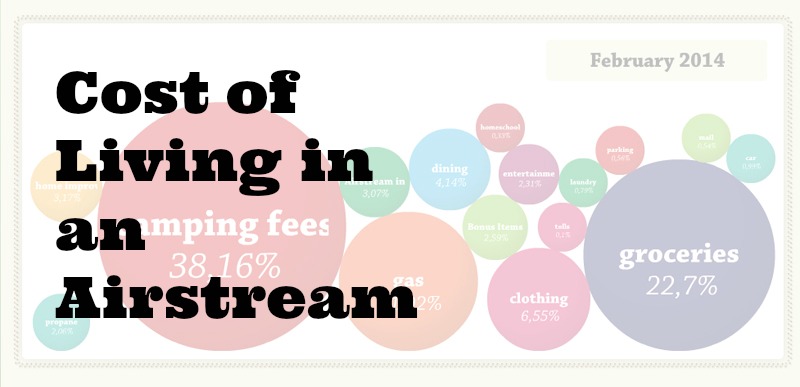
How Much Does it Cost to Live in an Airstream? February Summary

How Much Does it Cost to Live in an Airstream Feb 2014

What amazes me about life on the road is how unpredictable it is. One month can be completely different from the last, but that’s what makes it so exciting! At the same time, variety makes budgeting difficult.

I’ll detail a post later on about how I budget in general (because that’s not really Airstream life specific) but just know that these are not ALL of our expenses. Not even close. These are just the ones that are fairly Airstream specific. We still have health insurance, life insurance, entertainment, loans on the Airstream and truck, HSA contributions, children’s savings, mortgage and utilities on the house in Lehi… You get the idea.

But aside from all that, most people want to know what it’ll cost in the Airstream. The biggest differences for us are the camping fees, higher gas spending, higher groceries, laundry, and occasionally the higher eating out (only because we never really ate out before).

This month we spent 1 week at Disneyland in an RV Park, and then another week in San Diego (actually 2 – but we crossed into March). A little bit of courtesy parking, regional park in AZ, and a National Park in CA. So, pretty varied as far as camping fees go. BUT we also drove less. WAY less. So less gas money. It seems we average out between the two most months.

Here are February’s numbers:

Feb 1st: Halfway between Tuscon, AZ and Phoenix, AZ
Feb 31st: San Diego, CA

Total miles driven: 1,301
Total miles towing the Airstream: 687
Average Towing Miles per Week: 172

Camping Fees (State parks, RV campgrounds): $1029.55
# of Nights Courtesy Parked with a friend/free parking: 2
Gas: $321.59
Propane: $55.70 (way less! Hooray for an electric heater!)
Groceries: $612.45 (also includes all paper goods, and Pull Ups)
Laundry: $21.25
Dining Out: $111.81 (does not include eating out at Disneyland – that was budgeted separately)

Here’s our 3 month average for Dec 2013 – Feb 2014:

Average Miles per Month: 1997
Average Towing Miles per Month: 1194
Average Towing Miles per Week: 99.5

Camping Fees: $23.87/night
Gas: $594.22/month
Propane: $79.44/month
Groceries: $662.56/month
Laundry: $18.42/month
Dining Out: $126.07/month

Not too shabby. We originally budgeted about $40/night average, $700 for groceries, and $700 for gas. So, under on all three! This makes me very hopeful we can continue this lifestyle without too much stress. Hooray!

Categories
Finances & Money Most Popular Posts

Our Number One Recommendation to Prepare Financially for Life on the Road

Our Number One Recommendation to Prepare Financially for Life on the RoadAlthough it may seem like we jumped into the decision to abandon our lifestyle and go mobile, it has actually been a long time in the making. We didn’t just wake up one day and decide to sell the minivan, buy an Airstream and a truck and drive into the sunset.

So, what did we do?

Our biggest concern as we started planning and scheming was money. How would we afford this? Not just the everyday life, but the initial purchase of both an Airstream and a truck. We had 3 month’s worth of money saved in the bank as an emergency buffer (good idea in anyone’s situation I think) but in no way was it enough to cover the purchases. We definitely needed to finance, but wanted to make sure we’d still have money every month to buy groceries and gas after the monthly payments. As we started looking at our bank accounts we realized there were a few helpful things we were already doing.

1. We paid off our minivan in the spring of 2012. Instead of using that “extra” $600 for day to day life (however tempting that might have sounded) we began paying into a separate “car fund” savings account at our bank so that next time we needed to buy a car we could pay for it in cash. Separate account made it less tempting to spend.

2. We have been a 1 car family since the summer of 2012. Our Ford Focus’ engine died right before we left for California for 5 weeks. We eventually sold it on Craigslist and figured we’d buy another car when and if we needed it. We never have. We do realize Sam working from home really helps this situation. I’m definitely not the type of wife to be stuck at home while my husband has the car all day at work, but I could do it if necessary. If he had a commute, Sam could also bike, take public transportation, or carpool a few days a week so I could have the car to run errands. Lots of possibilities to free up a few hundred dollars a month.

3. We had maxed out our emergency buffer savings account and started putting that $500 into the car fund in addition to the $600 we were already saving.

We totaled up the amount in the car fund and it was a hefty enough sum to put a $5000 down payment on a used truck to lower our monthly premium while not completely draining the account. Once all our loans went through (that’s a different story – not many banks will loan to the self-employed) our monthly payments totaled $829, which turned out to be $270 LESS than the amount we were currently saving into the car fund. Our purchases of both a truck and the Airstream were not going to cost us any extra money per month. After we sold our minivan, that money went back into our savings account & car fund to bring those back up to reasonable levels. We still put that extra $270 into the car fund every month as we anticipate new tires, new batteries (did that one last week), and other improvements or repairs we’ll need to do along the way.

This brings me to our Number One Recommendation to Prepare Financially for Life on the Road:

Live below your means.

Well below your means if you can help it. I can’t tell you how many months I wished we had more money for eating out, taking the kids to movies, going on fun vacations, even groceries. Not stressing about my grocery budget would have made my life so much simpler. I’d look at that account transfer every month and think, “But if we just used a little of it…”

You know what? It was worth it. Every time we scrimped, every time we decided to not make a big purchase but instead save the money, every time I made dinner instead of eating out, we were one step closer to our dream.

Fulfilling and living our dream took sacrifice and planning. It hasn’t been an easy road (it still isn’t) but knowing that we are actually doing what we’ve always dreamed about is better than anything else we could have bought.