Categories
Airstream Accessories The Airstream Video

Don’t Steal My Stuff: Adding a lock to our truck’s tailgate

Don't Steal My Stuff - Adding a lock to our truck's tailgate

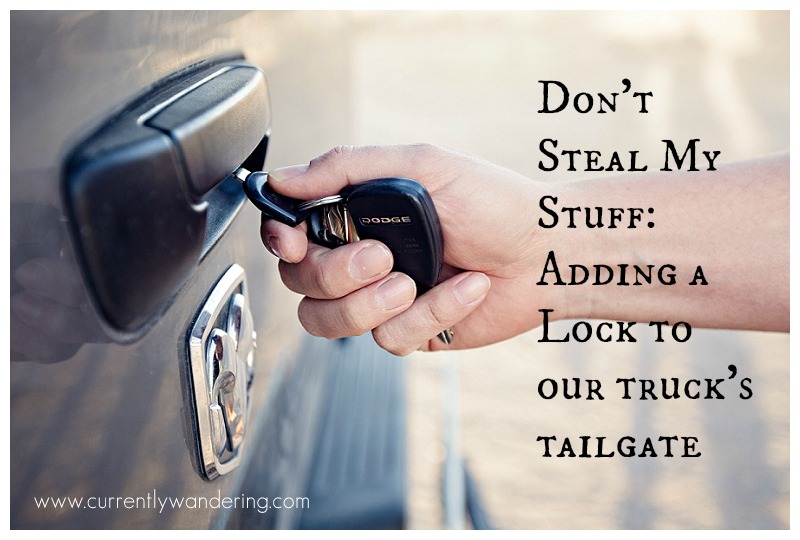
While getting the truck ready for traveling, I added a locking Tonneau Truck Bed Cover, and I needed a way to lock the tailgate to create a safe place to store stuff. While tailgate and truck bed covers are not perfect protection, they certainly go a long way to making it really inconvenient to dig through the contents of our truck bed.

The bed of the truck is a perfect place to keep the things not generally welcome inside an Airstream: generators, tools, and emergency supplies, as well as some long-term storage items in plastic storage bins.

Our truck did not have a locking tailgate when we bought it, but I found two reasonably priced options: The Pop Lock, and the Bully Lock.

Both of these aftermarket tailgate locks have models that fit most trucks on the market. These I linked to fit my Dodge Ram 1500, so make sure you find the right one for your vehicle.

I went with the bully lock, as it looked like a better install, and was less than half the price. The installation was fast and easy, provided you have the right star screwdriver and socket. I paid around $19 for the bully lock, and I’m happy with the result. It carries an OEM look, locks securely, and gives me the security I was looking for. I’ve been using it for a few months now, and have no complaints.

I recorded the install, so have a look if you are considering installing one yourself.

Categories
Daily Life The Airstream

Having Friends Over to Play

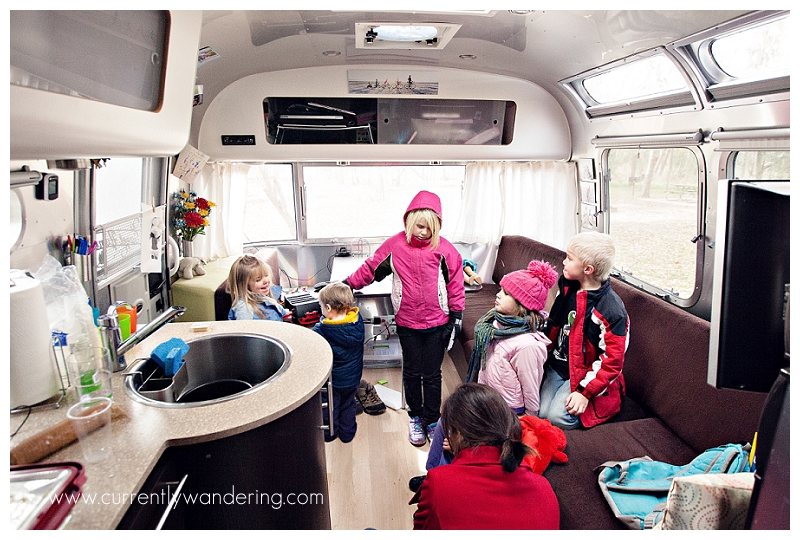
IMG_3716-Edit copyOne of the things I think my kids & I both miss are play dates. The kind where the moms get to sit on the couch and chat while the kids run around and play like cray for hours. There are a few friends back home where life is easier when they are over. The kids will just flit from one activity to the next with very little prompting leaving me to relax.

Having that kind of an experience while traveling and living in an Airstream is less common, but definitely still a possibility as we discovered while hanging out in Houston.

We have a lot of friends around the country – and while we get to courtesy park with most of them (it makes it easier to stay up all night talking when the kids can go to bed) sometimes schedules just don’t work out. We tried to meet up with some college friends on our way in to the Houston area, but my friend, Paige, wasn’t feeling so great so we postponed it to “later”. Well, Christmas came and went and while we were down in Brazos Bend State Park, Paige & her kids decided to come visit!

Honestly, I was nervous about entertaining six kids in 188 square feet. Not even 188 sq feet as Sam was working on the bedroom end. Did I mention that was also the week it was freezing cold and windy outside? We managed a short walk around the lake before everyone’s fingers and toes were frozen and we retreated to the warmth of the Airstream. Paige has 3 kids around the same ages as mine, so we pulled out some toys and let them climb over the couches and bed steering airplanes and cars over the furniture. Sam actually had to join a Skype meeting so he retreated to the truck so he could actually hear what was being said.

The consensus? Fairly chaotic, yet lots of fun! Paige & I got to chat (and occasionally break up a dispute) while the kids played, and we even fed everyone lunch! Totally going to pat myself on the back for that one. We LOVED having visitors over, and it was fun to share our space with friends. While it wasn’t hours on end, I definitely enjoyed my hour and a half of mommy chat time. If we are ever in your area, don’t be afraid to send us a message and set up a play date!

IMG_3701-Edit copy

Categories
Finances & Money Most Popular Posts

Our Number One Recommendation to Prepare Financially for Life on the Road

Our Number One Recommendation to Prepare Financially for Life on the RoadAlthough it may seem like we jumped into the decision to abandon our lifestyle and go mobile, it has actually been a long time in the making. We didn’t just wake up one day and decide to sell the minivan, buy an Airstream and a truck and drive into the sunset.

So, what did we do?

Our biggest concern as we started planning and scheming was money. How would we afford this? Not just the everyday life, but the initial purchase of both an Airstream and a truck. We had 3 month’s worth of money saved in the bank as an emergency buffer (good idea in anyone’s situation I think) but in no way was it enough to cover the purchases. We definitely needed to finance, but wanted to make sure we’d still have money every month to buy groceries and gas after the monthly payments. As we started looking at our bank accounts we realized there were a few helpful things we were already doing.

1. We paid off our minivan in the spring of 2012. Instead of using that “extra” $600 for day to day life (however tempting that might have sounded) we began paying into a separate “car fund” savings account at our bank so that next time we needed to buy a car we could pay for it in cash. Separate account made it less tempting to spend.

2. We have been a 1 car family since the summer of 2012. Our Ford Focus’ engine died right before we left for California for 5 weeks. We eventually sold it on Craigslist and figured we’d buy another car when and if we needed it. We never have. We do realize Sam working from home really helps this situation. I’m definitely not the type of wife to be stuck at home while my husband has the car all day at work, but I could do it if necessary. If he had a commute, Sam could also bike, take public transportation, or carpool a few days a week so I could have the car to run errands. Lots of possibilities to free up a few hundred dollars a month.

3. We had maxed out our emergency buffer savings account and started putting that $500 into the car fund in addition to the $600 we were already saving.

We totaled up the amount in the car fund and it was a hefty enough sum to put a $5000 down payment on a used truck to lower our monthly premium while not completely draining the account. Once all our loans went through (that’s a different story – not many banks will loan to the self-employed) our monthly payments totaled $829, which turned out to be $270 LESS than the amount we were currently saving into the car fund. Our purchases of both a truck and the Airstream were not going to cost us any extra money per month. After we sold our minivan, that money went back into our savings account & car fund to bring those back up to reasonable levels. We still put that extra $270 into the car fund every month as we anticipate new tires, new batteries (did that one last week), and other improvements or repairs we’ll need to do along the way.

This brings me to our Number One Recommendation to Prepare Financially for Life on the Road:

Live below your means.

Well below your means if you can help it. I can’t tell you how many months I wished we had more money for eating out, taking the kids to movies, going on fun vacations, even groceries. Not stressing about my grocery budget would have made my life so much simpler. I’d look at that account transfer every month and think, “But if we just used a little of it…”

You know what? It was worth it. Every time we scrimped, every time we decided to not make a big purchase but instead save the money, every time I made dinner instead of eating out, we were one step closer to our dream.

Fulfilling and living our dream took sacrifice and planning. It hasn’t been an easy road (it still isn’t) but knowing that we are actually doing what we’ve always dreamed about is better than anything else we could have bought.

Categories
Finances & Money

Paid Vacations for the Self-Employed

Paid Vacations for the Self-Employed

One clear difference between self-employment and a salaried job is the lack of paid vacations. I am paid hourly so when I don’t work, I don’t get paid. Without a bit of advance planning, it is easy to feel like I can’t take time off or relax without feeling the financial burden.

Having just spent a Christmas without that worry, I thought I’d share how I balance work and time off.

My secret is simple: I plan to complete the necessary work in 20 working days per month. Every month (except February) has more then 20 week days. This allows a few extra days per month for time off. I don’t have to wait for the end of the month for those extra days. I use them during the month as convenient. As long as I get 20 working days in during the month, I know I’ll make enough money. If I don’t need the vacation days, I’ll work like normal and save the billable time/money for days that I do want to take off.

Using this method, 2013 provided 21 extra week days:  enough for a full month off. I’ve used that time for sick days, birthdays, holidays, “mental health” days, and if I choose to work, “bonus” money.

This math also makes it easy to figure out how much money I need to bill each day: I calculate my pre-tax monthly required income (paycheck + income tax), and divide by 20. That is the dollar amount I need to invoice each day. Divide that amount by my hourly rate and I get how many hours I need to work on each work day.

Should I want additional time off, I work more than my hourly requirement on days where nothing too exciting is happening. There are some days I settle in and work 8-9 hours instead of my normal 5-6. This allows me to get ahead and build up some extra vacation days. I bill monthly (see my How We Travel Without Being Independently Wealthy Post) to allow me the flexibility to average my hours over a longer period of time. Billing every two weeks would shorten that time span, but can also work well.

Time easily converts to money: If I want a bonus instead of time off, we bill for the extra hours I work instead of saving that time for vacation.

Because I know my plans rely on a 20 workday month, I’m free to enjoy my days off without stress and worry.

Questions? Confused? Please ask!


Categories
Finances & Money

How Much Does it Cost to Live in an Airstream? December Edition

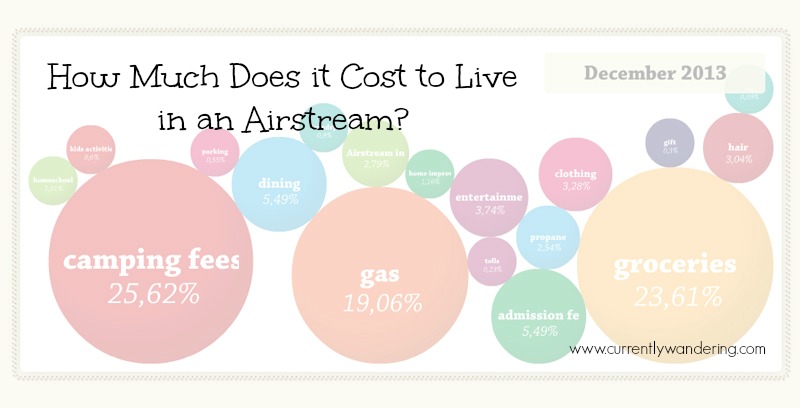
How Much Does it Cost to Live in an Airstream Dec 2013Sam & I talk often about the costs of living on the road full time. How much money is it going to take? Can we really make this work? Honestly, we are not sure yet. We have a few numbers in mind from our own experience as well as others’, but because we are so new at this we don’t have much data yet.

As an experiment, we thought we’d do a monthly summary of our main expenses over the last 30 days or so. We felt like this would give our readers a general overview of what it takes financially, as well as give us a running comparison of numbers. So, here we go:

December 1st: Tampa, FL
December 31st: South Houston, TX
Total miles driven: 2,247
Total miles towing the Airstream: 1,228
Average Towing Miles per Week: 277

Camping Fees (State parks, RV campgrounds): $842.45 ($31.20/night average)
# of Nights Courtesy Parked with a friend/free parking: 4
Gas: $626.88
Propane: $83.62
Groceries: $776.32
Laundry: $29.75
Dining Out: $180.58 (ouch! I didn’t think we ate out THAT much. It must’ve been the beignets in New Orleans!)

Obviously there are more expenses (clothing, entertainment, decorative upgrades, etc.) but these are the main ones. The thing is, what it costs to live on the road is highly subjective. Just as living in a house can be. How nice of an RV Park or Campground do you want (camping fees)? How far are you traveling every week (gas)? How many people in your family (groceries)? How cold is it outside (propane costs)? What do you like to do for fun (entertainment)? These costs completely vary from family to family just as they would in a brick house.

There are definitely plans in the works to cut down on both camping fees and gas (just bought new batteries for the Airstream, we’d love some solar panels, traveling SLOWER). Getting to milder climates will also save on propane, and dang. We could definitely eat out less. That number still surprises me. Was it the seafood? The ice cream?

If you’d like another opinion on costs of traveling full-time, our instagram friend Kyle has a great article that breaks down various costs on his blog Where Is Kyle Now? Go check it out and let us know what you think!