Categories
Finances & Money

How Much Does It Cost to Live in an Airstream? May – July 2015 Summary

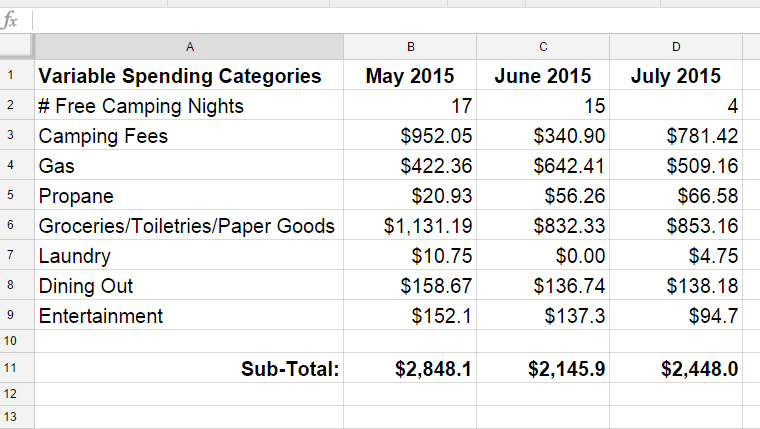
Airstream Living Cost July 2015

Wow. Its been awhile since I’ve done one of these posts. About time I guess.

Standard disclaimer that this is not ALL the money we spent for these months. Not even all our discretionary shopping – just the categories I feel that people would find most interesting. To learn how I work my budget see this post.

A couple of notes about May 2015 –

Camping Fees -We stayed for free at my brother-in-law’s house in Idaho for the majority of that time. We helped out with some purchases (he was also helping us weld a new battery box) and we just didn’t have him pay us back and allocated that money spent as “camping fees”. It was about $200.

We also reserved spots in the Florida Keys (Dec) and in Minnesota (June) for a total of another $480 – which we count when we spend it, not when we actually stay there. So, realistically our 17 days of free camping helped us spend a whopping $272 in May. I just didn’t want anyone to freak out and wonder where on earth we stayed for the 14 days we did pay for.

In June we spent quite a bit of time at my brother’s house in Minneapolis. To balance that out, the state and regional parks are not cheap and there’s very little free boondocking anywhere in Minnesota. We barely went over our $700 budget in July and I think that’s pretty accurate for the Midwest. We are currently trending to go over budget by quite a bit in August.

Laundry – I get a lot of people wondering how we keep laundry so low. Granted, I think I’m terrible at tracking it as I usually pay in cash. BUT, I think the biggest factor is that our kids literally wear the same clothes at least 3x a week. Its just not that much laundry. I figure if the clothes don’t smell bad and aren’t visibly dirty, why on earth would I wash it? Wear it again. My kids get in trouble if they are lazy and put their clothes away in the dirty clothes instead of their closet.

Same goes with adult clothes. I will often wear the same shirt/pants at least two days in a row.

We only wash our sheets 1 maybe 2 times a month (depends on how bad they get). We also wash our towels (5 bath towels, 2 bathroom hand towels, 4 dish/kitchen towels, and 4 wash cloths) about every other time, or half of them every time. When you shower every 2-3 days, washing bath towels every week seems overkill.

Its pretty regular that at least once a month we’ll end up at someone’s house and they’ll offer their washer and dryer for our use. Don’t mind if I do.

Groceries–  I bought two months worth of Shakeology in May (which adds up quick). We also stocked up in Pocatello/Idaho Falls at Costco and Winco before heading to said brother-in-law’s house in Driggs, ID for 10 days. Groceries are expensive out in Driggs.

I am wondering if NOT shopping at Costco would actually save me money since I probably overspend there every time anyway.
July spreadsheet

Categories
Daily Life The Airstream

Why Did We Decide on an Airstream Trailer For Full Time Travel?

Thinking about full time RV family travel? Check out our 6 Reasons We Chose to Live Full Time in an Airstream camper with three kids!

We get asked quite frequently why we chose an Airstream to travel in full time. Many people love how they look, their functionality, their definitive “American-ness” but don’t see them as practical for full time families. Originally, our plan was to buy a Class C RV (the ones that look like a truck cab with a bed over the cab) and travel 4-6 months at a time. Once we were introduced to Airstream trailers and started playing around with the idea of full time travel, we decided we really wanted one and just needed to figure out how to make it work. So far, so good.

There are quite a few reasons we chose an Airstream over an SOB (Some Other Brand) and I’ll give you our top 6:

1. Airstream Trailers Hold their Value. We bought our used 2008 27FB International for a fraction of the cost of a new one ($95,000). With all the upgrades we’ve done included solar, battery box, inverter, antennas,  bed conversion, etc. we think we’ll be able to get most, if not all, of our money back out of it. Not bad for living quarters for a few years.

2. Airstream Trailers Are Built Well. On our first mini-van road trip, we visited the Airstream factory in Jackson Center, OH and saw how these trailers are built. While many RV’s use copious amounts of particle board, Airstreams have none. The shell is assembled first, sent through a water spray to test for leaks, and then all the insides are assembled. These also means everything inside the Airstream can fit through the door, which makes remodeling much, much easier.

3. Airstream Trailers Are Modern Without Feeling Like a Badly Decorated Hotel Room. I don’t know how else to describe this one. Most of the RV’s we toured (and we did look at quite a few) felt like badly decorated hotel rooms, or even too close to a house (island in the kitchen, large pantry, huge leather sofa, etc). We wanted different. We wanted a space ship for Earth, not an almost-house. Many people are surprised with how modern and sleek the interior of our Airstream is. We love it.

4. The Airstream Community is Phenomenal. This is a huge one for us. We started playing with the idea of going full time and watched families like @Malimish_Airstream, @Worksology, and @TinFoilHouse on Instagram. We loved how they interacted and supported one another and just wanted to be part of that community. Since we’ve been on the road, we haven’t been disappointed. It seems that having an Airstream is a perfectly acceptable reason to knock on another’s door and just say “hi”.

5. Airstream Trailers Are Small. One of my favorite comments has been, “But there’s not as much storage in an Airstream!” Our answer is, “Yes! Isn’t it great?” Because of the curves, there’s not as much storage up in those corners and I’m totally happy with that. Less stuff = less clutter = less to worry about. We don’t want more room for “stuff”, our goal was to have less.

We are also under 10 feet tall, and about 8.5 feet wide, which is great for parking under trees or in small campgrounds. There’s many places we’ve been able to fit and stay that many of our larger RV friends can’t. I love being IN the national or state parks, not at an RV park nearby because that’s the only place we could fit.

6. Airstream Trailers Tow Really Easily & Get Decent Gas Mileage. Airstream purposely designed their trailers to tow easily, and they really do. I have no problem driving, and most of the time I feel like I’m driving just the truck – not also hauling an 8,000 lb trailer. They are aerodynamic which helps with wind and also improves gas mileage.

While an Airstream is definitely not for everyone, we have really enjoyed traveling full time in ours and don’t regret our decision!

Why Did We Choose an Airstream For Full Time Family Travel

Categories
Solar & Power

Solar Power Upgrade Part 4 – The Wire Panel

With the solar mounted on top (part 1, part 2) and the wires run to the forward compartment (part 3), there was only one thing left to do. The next step in my project was to connect it all up!

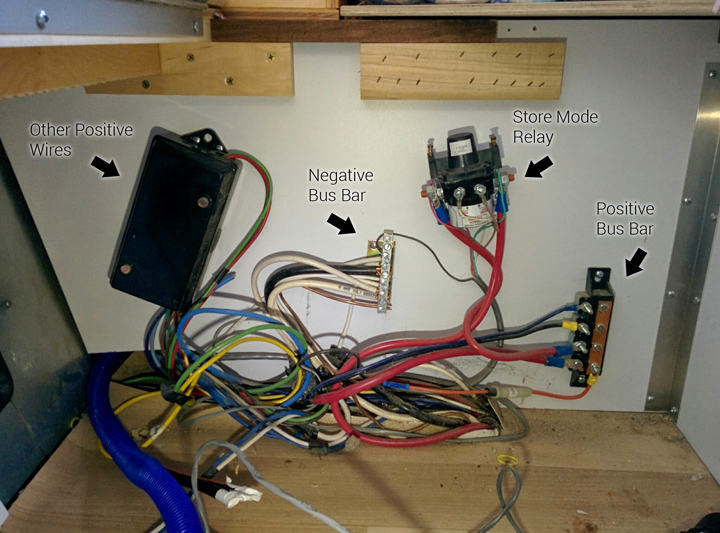
Underneath Cara’s bed is the wiring panel where the battery is connected to the rest of the DC wiring. This is a prime location for the solar charge controller because of it’s proximity to the batteries. Later, I’ll install the inverter nearby for the same proximal reason. The existing wiring in this location was a positive bus bar, a negative bus bar, the ‘store’ mode disconnect relay, and a positive DC breakout box.

IMG_20150223_075750_labels

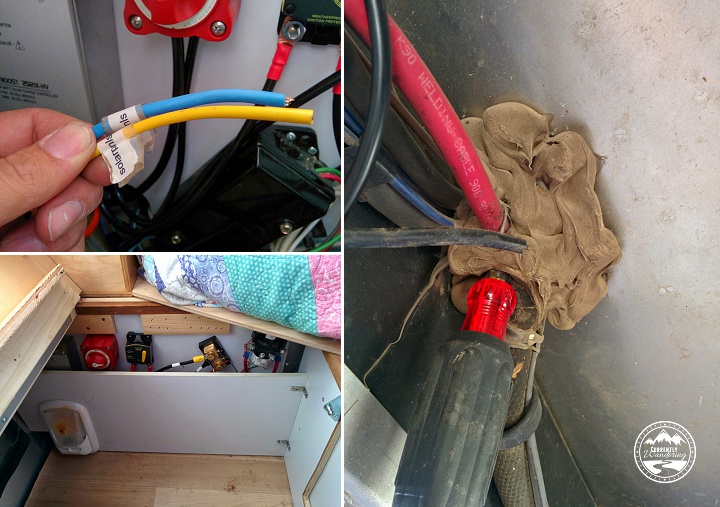
Also found in this location was the ends of the solar pre-wire placed by Airstream. I knew they were there, but the wire gauge was so small that I had to replace it anyway.

As I was adding plenty of components, I had to do a little rearranging of the existing components. They were just screwed into the plywood panel, and I was able to re-arrange them without too much difficulty.

IMG_20150223_144008_labels

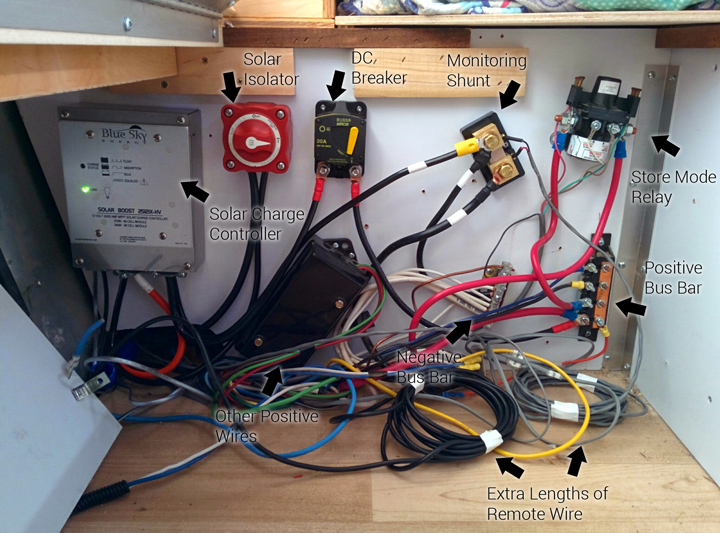
In principle, the solar panels are wired to the solar charge controller, and the solar charge controller is wired to the positive and negative bus bars. In practice, there are a few additional details.

The first component I installed was the isolator switch on the positive wire leading from the solar panels. By switching this off, I was able to protect myself (and the equipment) from an accidental short during the rest of my wiring project. (A ‘short’ is when you accidentally connect two wires that are not meant to be connected. Ever accidentally touch the clamps of a jump start cable together? That is a short.) After installing the isolator switch, I left it off for the rest of my install.

I next wired up the solar charge controller. A short run from the just installed isolator switch on the positive side, and the negative side of the cable from the rooftop panels. The next step involved connecting the ‘out’ side of the controller to the existing DC system. The positive side of this connection is run through a switchable 30 amp DC breaker. This switch automatically flips off if the solar charge controller attempts to output more than 30 amps. With a maximum output of approximately 24 amps, I suspect this will never trip. It DOES serve as additional protection, and also as an extra isolator switch should I manually switch it off. The positive side is then wired to the positive bus bar.

The negative side of the charge controller ‘out’ connection can be wired directly to the DC bus bar, but I cheated slightly and attached it to our last new component: The battery monitoring shunt. This magical component can measure the flow of electricity from one side to the other. This enables both a real-time view of charge/drain activity on the battery, as well as keeping track of how many ‘amps’ or amp-hours are left in your battery. This measure is unaffected by load (like voltage) and gives a great indicator of battery charge state at a glance.

The monitoring shunt is installed between the negative terminal of the battery and the rest of the negative half of the DC system. I moved the negative battery cable from the DC bus bar and connected it to one side of the shunt, and added a new cable between the other side and the DC bus bar. Now, every use of DC power can be monitored. More on that later.

I connected the negative side of the charge controller DC ‘out’ to the shunt as well, on the non-battery side. (ONLY the battery should be connected on that side of the shunt. EVERYTHING else is connected on the other side.)

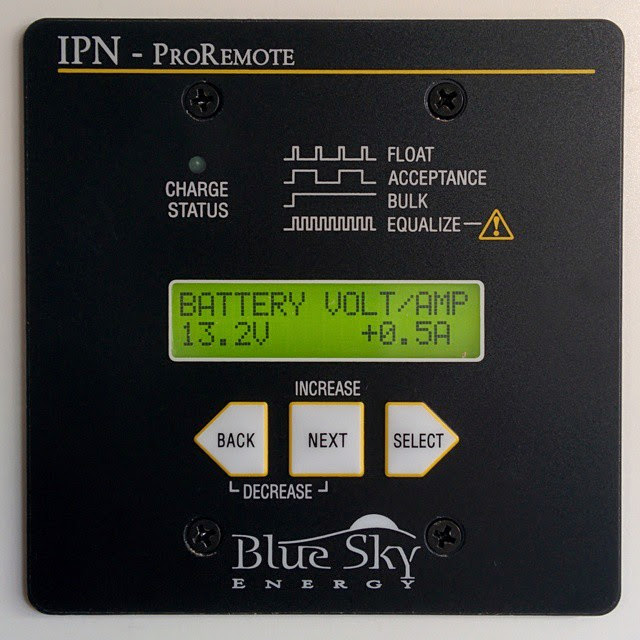
At this point, everything ‘major’ is in place. In part 3 of this series, I mentioned running remote cables from the kitchen cabinet down to the electrical panel and along the same run as the solar wire. At this point, I attached these remote wires to their various components. The IPN Pro Remote cable attached to the solar charge controller. The shunt monitoring cable attached to the shunt with little screw mounts.

The last step I’ll describe was really the hardest step of this last phase. The solar charge controller has a remote temperature sensor that allows it to adjust it’s charging based on the temperature of the battery. This cable attaches to a battery terminal in the battery box, and to the solar charge controller inside the Airstream. The existing battery cables are run through a heavily caulked hole in the floor. By poking carefully with a phillips screwdriver, I was able to poke a hole through the middle of the bundle without damaging any existing wire. After attaching it to the battery and threading it out of the battery box, I ran it alongside the battery wires, and protected it with some plastic wire wrap. I shoved it through the hole I poked, and then squooze a bunch of silicon sealant around the wire from the top and the bottom. The sensor attached easily to the charge controller, and then I attached the cover.

IMG_20150223_132519
The weak-sauce wires prewired for solar, my screwdriver hole making method for the temperature sensor, and how it all looked with the protective panel reinstalled.

At this point, everything was installed. I only needed a short length of wire and a few wire terminals from the store, and everything else was provided in the installation kit from AM Solar. Between their instructions and the inspection of Dave Zimmerman’s wiring, I was able to work out all the details and complete the self install.

The only thing left to do was to flip the system on. I started with the solar isolator switch, but nothing lit up upon flipping that on. Next was the 30 Amp breaker, and that did the trick. Things started blinking, the power in the Airstream worked again, and I immediately started my addictive ‘check the solar monitor’ habit.

10919134_454446811386230_1784970774_n

Really, I’m surprised that everything worked out as well as it did. I re-attached the plywood panel that covers the wiring, and the project was complete. Really, I had a few random things to do, like zip-tie wires in various places, but it all feels better when the darn thing works!

Categories
Solar & Power

Solar Power Upgrade Part 3 – Self Install Running Wire

At the conclusion of Part 2, we had panels mounted on the roof and wired up to the combiner box. We connected the 6 gauge wire to the combiner box and dropped it behind the fridge. The next phase of this project involved running the wire from behind the fridge to the forward compartment. In the forward compartment, I’ll wire it up to the solar charge controller. But first, we must get there.

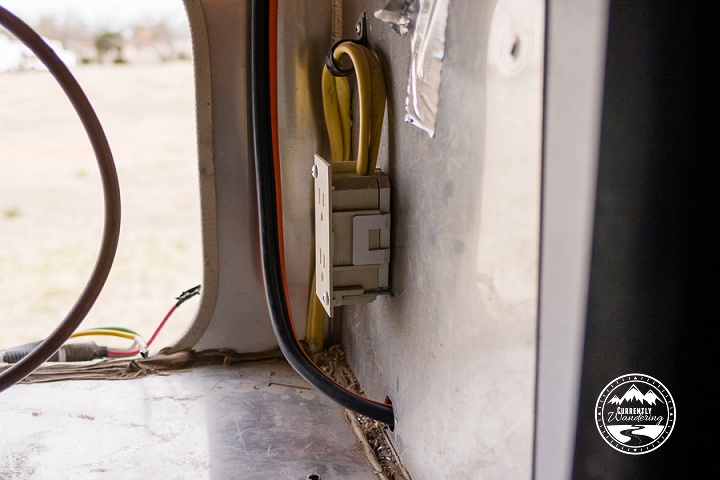
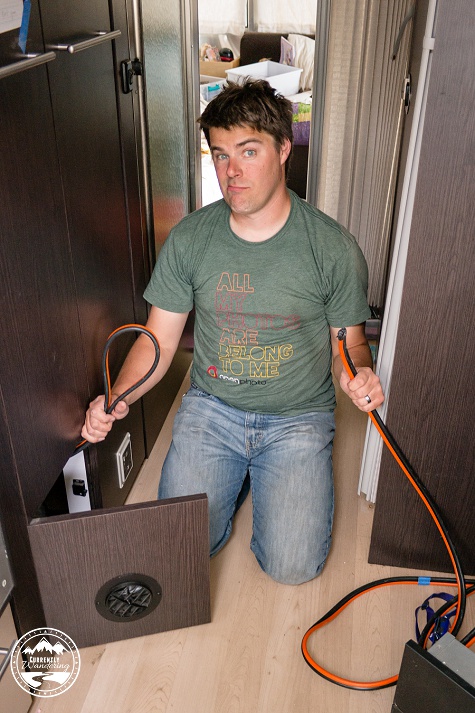
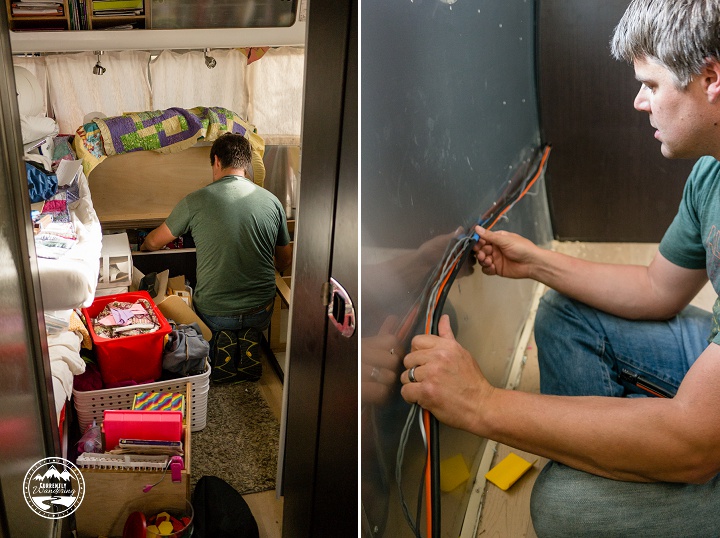
I drilled a hole in the lower segment of fridge compartment side wall. The side wall there is plywood with a metal covering. I drilled through both the metal and the wood, enlarging the holes so it fit the 6 gauge wire. That hole places the wire in the utility space underneath the wardrobe. Solar project_19In the utility space there is one side of a wire chase that runs side to side under the hallway down the middle of the Airstream. The other end of the wire chase comes up behind the electrical panel and underneath the pantry. I pulled the electrical panel out, which is pretty easy to do. I had done it several times before, most recently to upgrade the single stage converter to a multi-stage converter. Threading the wire through that wire chase was actually easier than I had imagined. After pushing the wire into one side, I was able to pull it out of the far end using my fingers. After I had a handle on both sides, I was able to thread the remaining wire pretty quickly.

Me, looking both tired and surprised at how easy the wire chase was.

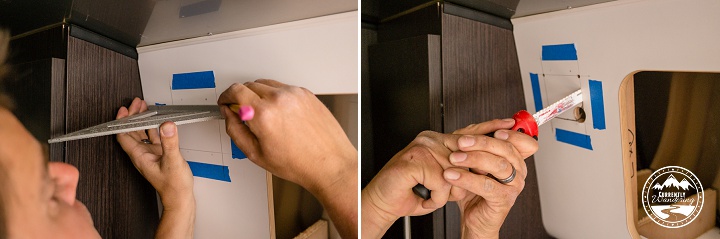
I paused my wire-running activities here to install the remote control panel for my Blue Sky solar charge controller. I measured and taped, and then drilled holes and used a small hand saw to cut the right hole for the controller in the upper kitchen cabinet. Solar project_20We fed the wires through a new hole in the pantry panel, and down the back of the pantry to meet up with the 6 gauge wire from the roof. There were two wires connected to the remote control: the remote control wire for the charge controller, and the shunt wire that connects to the battery monitoring shunt that I would install. After joining the main 6 gauge solar wire, these wires followed the same route for the remainder of the trip.

I then ran the wire through the side wall and above the hot water heater under the bathroom sink, later securing them with zip ties to to the underside of the shelves. I then ran the wire behind the back of the bathroom cabinets, and through a hole I drilled in the bathroom wall and into the bedroom.

My wiring route at this point is very specific to my bedroom configuration. During the remodel last year, I removed the walk-around queen and installed two rv-twin sized beds along the side walls, and a toddler sized bed in the very end. This configuration means that the remainder of my wire run is hidden underneath one of the side beds.Solar project_24

If you have a walk around queen, the wire run would not be hidden. In this case, the best solution I have seen is to run the wires along the floor, have a metal wire cover made, and screw it down to cover the wires. This solution is very nice looking, and barely noticeable at all.

I should mention here that an alternative wire run is possible. I’ve seen several installations where they ran the wire out through the bottom of the Airstream, through some conduit, and back up into the forward compartment. I didn’t like this solution for several reasons, including durability and aesthetics, but it might be a viable option if none of the other wire route paths work.

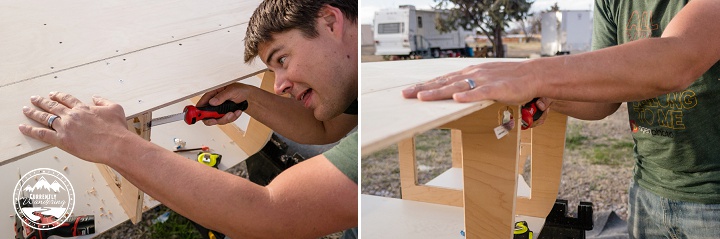
To run the wire underneath the bed, I needed to cut a notch in the vertical supports of the bed. When my Father and I designed the beds, we designed them to be removable without full disassembly. I emptied the storage compartments, removed some trim, and pulled the bed outside to make the cuts.Solar project_26

In the corner underneath the kids’ bookcases between the side bed and the back bed is a bundle of wire. During the bed remodel, I had made a cover for that wire bundle, and the added 6 gauge wire fit in just fine. I ran the wire along the same path, which led it right into the wiring panel underneath the front bed compartment.

I put the side bed back into place, replaced the electrical panel, and sealed the wire path in the fridge compartment with some silicon.

The next step is the big electrical re-wire!

Categories
Solar & Power

Solar Power Upgrade Part 2: Self-Install Combiner Box

image2
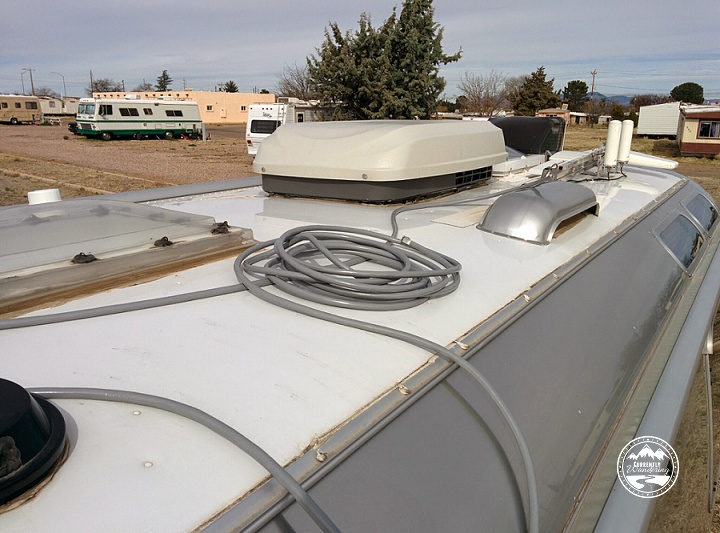
At this point of the install, each panel was mounted on the roof, with a wire connected to each panel and routed along the roof to the fridge vent. The next phase of the project requires connecting the three panels together in what is called a combiner box. Each of the negative wires are connected to a negative bus bar, and the positives to the positive bus bar. This effectively wires the panels together in parallel, which is a better setup if one of your panels ends up partially in shadow.

Two combiner boxes are possible here. If you plan to drill a hole through the roof to run the wire, a roof-top combiner box is what you need. This is the method you want to use if you plan to use the pre-installed wire many Airstreams come with for solar. I’ll explain later why this is probably a bad idea.

The second type of combiner box is called a fridge combiner box, and is used when you will be running the wire down the fridge vent instead of drilling a hole directly in the roof. Because of the type of refrigerator used in most RVs uses a heating element often powered by propane, there is usually ventilation placed above the fridge. This offers a convenient way to get cables inside without drilling holes, and is indeed the method I used to get three antenna cables inside. The fridge combiner box mounts with VHB tape and screws to the side of the fridge vent, and a hole is drilled to run the wire down the space behind the fridge and to wherever you need to route it.

The instructions provided by AMSolar are really quite good, but they really fell over during this phase of the install. The instructions want you to first mount the combiner box to the fridge vent, and then attach all the wires. This became an obviously bad idea when out of curiosity I tried to stick the 6 gauge wire pair through the indented hole in the combiner box. The wire was not even close to fitting through the hole. (See the image on the left.)
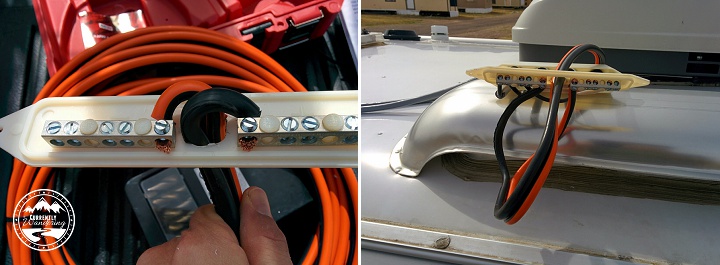
image16

At this point, I used my ‘phone a friend’ option and gave Dave Zimmerman a ring. He confirmed that the hole was ludicrously small and that heavy modification was required. I enlarged the hole with a drill, a utility knife, and most effectively a round file purchased from the hardware store in yet another run. I even went so far as to strip the end of the 6 gauge wires and test mount them to the combiner bars. This helpfully revealed that the hole needed to be even bigger to successfully bend the wires into a space small enough to fit inside the combiner box cover.

Using the combiner box as a guide, I used a sharpie to mark the size of the now-much-larger hole onto the vertical side of the fridge vent. Please excuse the poorly aimed and fuzzy picture. I took that with my spare hand with no reference to aim for a better picture. I could have mounted this box on the street side of the fridge vent, but it would be highly visible and fairly ugly. I mounted it to the opposite side, where it would be nearly entirely hidden from view. This required doing the hole-drilling work while standing high on the 8 foot ladder, leaning heavily on the fortunately sturdy fridge vent cover.
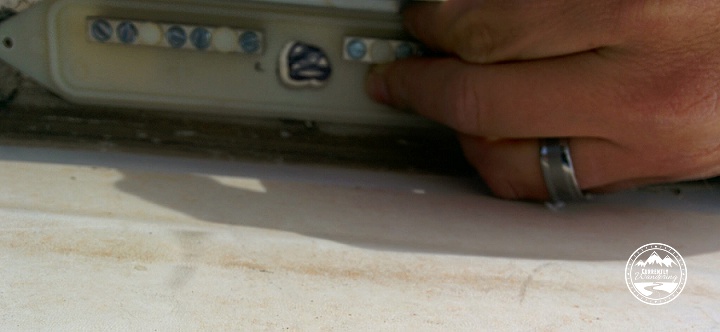
image15

Starting with the drill and finishing with the round, flat, and triangular files I bought in a set, I produced a hole large enough for the wire and dull enough not to immediately slice through the wire’s insulation. Before I removed the refrigerator for the next step, I took the time to wire each panel to the bus bars inside the combiner box. Each panel kit came with a black thing that mounted to the combiner box cover with a hole for the cable. Upon tightening this black thing with a wrench, an internal rubber gasket produced a water-tight seal against the wire to protect it from the elements. Assembling the black things to the combiner box, I pulled the panel wires through the holes and estimated their final length.

Before I proceeded, I wanted to make DARN SURE I was wiring up the panels correctly. I pulled out my little multi-meter and tested the wire from each panel. The test is easy: place the positive probe (red in my case) to the wire that should be positive, and the negative probe (black in my case) on the wire that should be negative. If the voltage reading is positive, you are correct! If the voltage reading is negative, the wires are switched. (Go ahead and switch the probes to see the negative values… it won’t hurt anything). The AMSolar Instructions had me use the black wire for positive and the white for negative, and each panel was wired correctly.
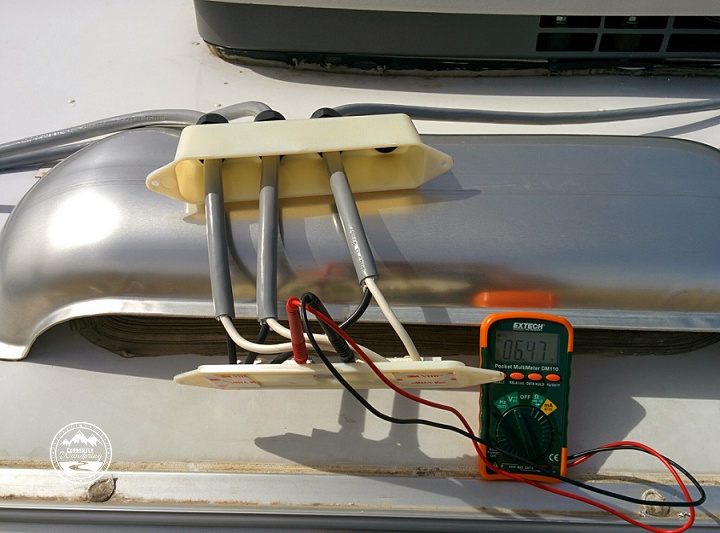
image17

I was a little surprised to see the voltage I did on each panel. Remember that in the first step, I taped a piece of cardboard over the front of the panel to keep generated voltage low. Even with nearly full blockage, I registered over 6 volts per panel! As it was, I was glad to have enough current to verify positive and negative before I completed the wiring to the combiner box.

The combiner box cover wasn’t very large, so the outer insulation of the panel wires needed to be cut to rest just inside the cover. The two internal wires were also insulated, and needed to be cut at odd lengths so that one of the wires could attach to the near bar, and the other to the far. The included instructions actually did a decent job explaining this part. After marking the desired length, I cut the wires to allow for the right length of internal wiring, then set about connecting them to the combiner box. I did this sitting on top of the 8 foot ladder, with the combiner box resting upon the fridge vent cover.

At this point, it was time to pull the fridge. I’ve done this a few times before, and it isn’t as hard now as it was the first time. First, turn off the propane valves on BOTH tanks. Second, I disconnected the DC wires from the back. Wrap those separately in electrical tape to avoid disconnecting power to the entire trailer. Next, pull the AC plug, disconnect the propane pipe, and push the fridge drain hose back through it’s holding strap. Remove the two hex-head large screws holding the metal rails to the floor. Inside, remove the four screws holding the fridge in place. The two screws on the bottom are easy to see and remove. The top screws are a little more hidden. Though possible to remove as is, I find that removing the top plastic piece (that contains the fridge temp display) makes them easier to get to. Keep track of all these screws.

The fridge can be removed by two people and set on the floor in the hallway. We used some of the panel packing cardboard to set the fridge on to prevent any damage to the floor.SAMSUNG CSC
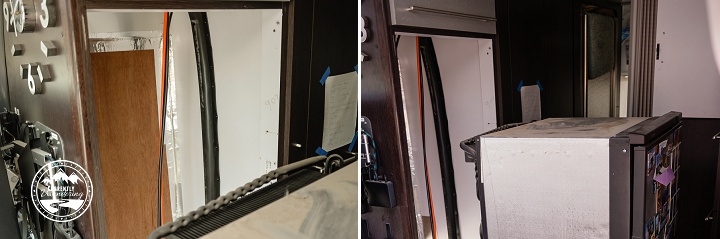
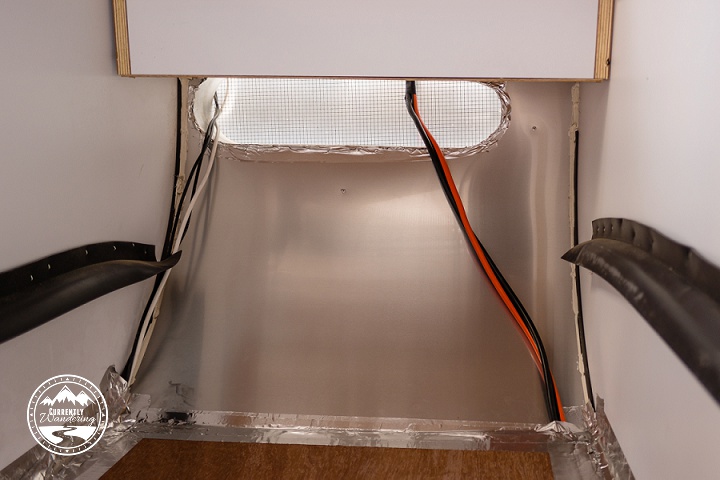
With the fridge removed, I pushed the end of the 6 gauge wire pair through the hole in the fridge vent and went back outside. Back on the ladder, I pulled the wire out far enough to comfortably wire it into the combiner bars. At this point, I was VERY glad I had tested this first while on the ground. With all the wires attached in the combiner box, I removed the tape, applied the included putty around the hole, and stuck it to the side of the fridge vent. I drilled pilot holes and secured it with the included screws.Solar project_18
At this point, nearly all my work on the roof was done. Later on in the process, I used the included zip-ties and sticky pads to secure the panel wires to the roof in a few places. I also sealed around the feet with lap sealant as previously mentioned, and I also removed the cardboard after the wind removed one of them for me.

The next step of the process is running the wire from the fridge vent all the way through the house to the forward wiring compartment. Join me next time for more solar fun!